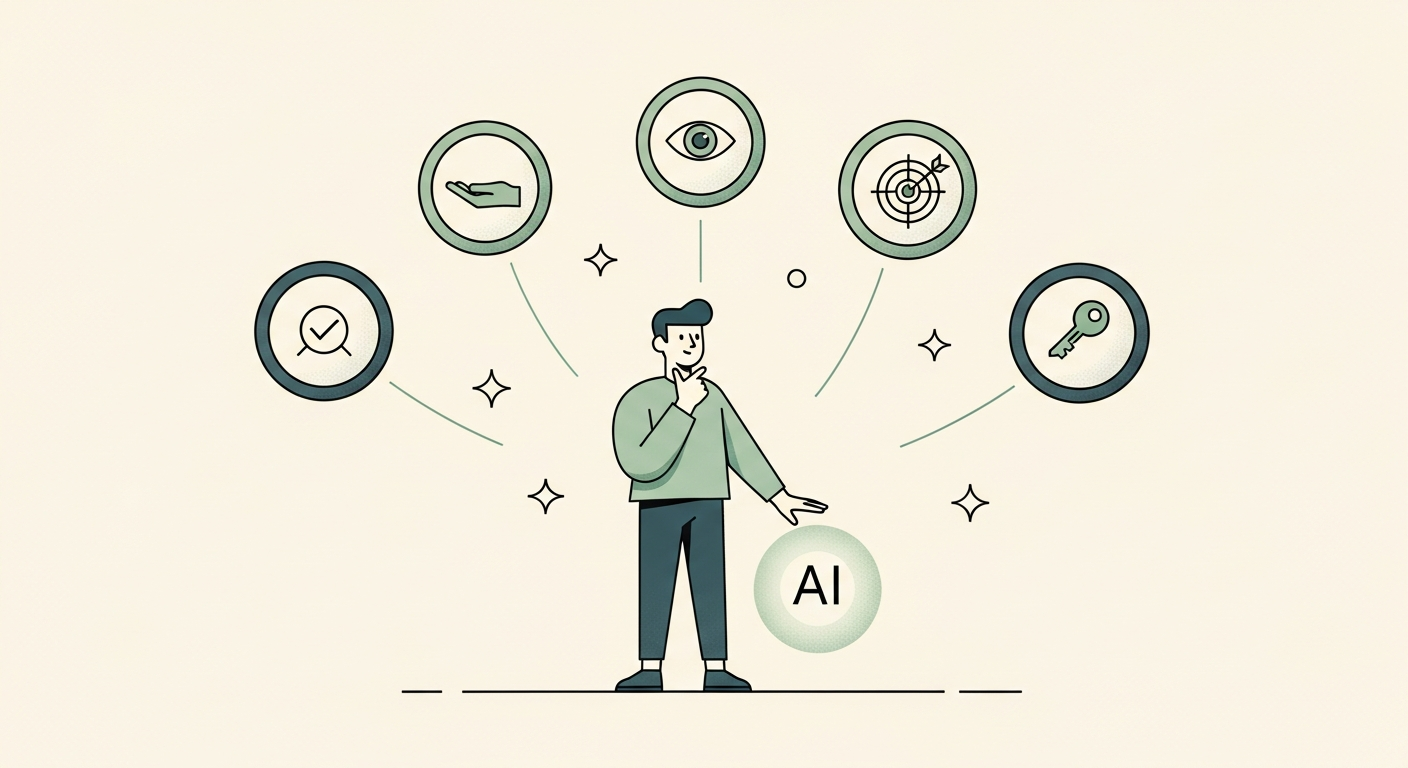
If you search for "the 5 rules of AI" you will find a dozen different lists, because the rules of AI are not codified in a single agreed standard the way the laws of physics are. What does exist are principles, frameworks, and operating rules that the most credible AI programs and most widely adopted governance frameworks tend to converge on. Across NIST, OECD, ISO/IEC 42001, the EU AI Act, and the published practices of the major model providers, the same handful of ideas keep showing up.
This guide distills them into five clear, practical rules that work as a checklist for any leader, team, or individual using AI today. They are not the only useful framing, but they are the framing we have seen hold up across hundreds of real conversations with companies trying to use AI well without creating new problems. If you internalize these five rules, you will be much better positioned to catch common failure patterns before they become incidents.
The 5 Rules of AI
Rule 1: Keep Humans in Control
AI is most useful as an assistant, not as a replacement for human judgment in consequential decisions. The first rule is that a human stays accountable for the outcome of any meaningful action the AI is involved in. The human can be in the loop, on the loop, or out of the loop depending on the stakes, but the chain of accountability never disappears.
In practice this means a few specific things. For high stakes decisions like hiring, lending, medical triage, or customer escalations, a qualified person reviews the AI's recommendation before it becomes action. For lower stakes work, the human may only spot check, but the system is designed so the human can intervene at any point. For autonomous AI agents that take actions in the real world, the scope, permissions, and stop conditions are defined deliberately in advance.
The failure pattern this rule prevents is the slow drift toward letting AI make decisions no one is actually reviewing. That drift usually happens not because anyone decided to remove the human, but because the volume grew, the human review became symbolic, and one day a bad output went out the door because no one had the time to catch it. The rule forces the question to be answered explicitly: who is responsible for this output and do they have the capacity to actually exercise that responsibility.
Rule 2: Be Transparent About What AI Is Doing
The second rule is that the people affected by AI deserve to know it is being used and to understand how at a level appropriate to the situation. Transparency operates at several layers.
Customers should know when they are interacting with AI rather than a person, especially in contexts where the assumption would otherwise be a human. Employees should know which of their tools and workflows include AI and what role the AI plays. Regulators and auditors should be able to see how a decision was made when they ask. Internally, leadership should have a clear inventory of AI in use across the company so the picture is not held entirely in the heads of the teams running individual workflows.
Transparency also extends to the limitations of the system. Saying "this AI sometimes gets things wrong, here is how we catch the mistakes, here is what to do if you spot one" builds trust. Pretending the system is more reliable than it is destroys trust the first time a visible mistake happens.
The failure pattern this rule prevents is the slow erosion of trust that happens when people discover AI was involved in something important and no one told them. Once that trust is broken it is very hard to rebuild, and the same disclosure up front would have cost nothing.
Rule 3: Use AI on the Right Problem
The third rule is that not every problem is an AI problem, and even the problems that are can be approached well or badly. Choosing the right use case is a discipline in itself, and skipping that discipline is one of the most common reasons AI investments fail to deliver.
A good use case for AI has a few characteristics. The work is repeatable or pattern based, so the AI has something to learn from. The cost of an occasional wrong answer is bounded, or there is a human review step that catches the wrong answers before they cause damage. The data needed to do the work well is available and usable. The downstream system can actually consume what the AI produces. The people who will use the workflow understand how to work with it.
A bad use case for AI usually looks like the inverse. Decisions where one wrong answer can cause serious harm and no one will catch it in time. Workflows where the data is messy enough that the AI has nothing reliable to work with. Use cases bolted onto systems that cannot actually accept the AI output. Tools deployed to teams that have not been trained to use them well.
The failure pattern this rule prevents is the company that buys AI tools because everyone else is and then tries to find problems for them to solve. The right order is to identify the problem worth solving, then ask whether AI is part of the right solution, and only then choose the specific tool.
Rule 4: Verify Before You Trust
The fourth rule is that AI outputs should be treated as a high quality first draft, not as a finished answer. Modern AI models are confident by design. They produce fluent, plausible answers even when those answers are wrong, a behavior known as hallucination. The right operating posture is to verify before you act, with the level of verification proportional to the stakes of the decision.
For a quick personal email draft, verification might be a thirty second read. For a customer facing announcement, it is a careful edit and a fact check. For a regulatory filing, it is the same diligence you would apply to any other regulated work. For an autonomous agent action, it is logging and monitoring that can detect when the agent has done something it should not have.
Verification also includes checking AI outputs for the specific failure modes the model is known to have. Hallucinated citations, fabricated statistics, made up product features, subtly biased recommendations, and stale information are all common. A team that knows what to look for catches these mistakes routinely. A team that does not learns about them from customers and journalists.
The failure pattern this rule prevents is the published, shipped, or sent output that turns out to be wrong because the AI sounded confident and no one questioned it. Many of the public AI incidents in the last two years trace back to a missing verification step that should have caught the problem internally.
Rule 5: Own the Outcome
The fifth rule is that the company or person using AI is responsible for what the AI does on their behalf. The vendor matters, the model matters, the workflow matters, but the accountability rests with the entity that put the AI into production.
This rule has both internal and external dimensions. Internally, every AI use case should have a named owner who is responsible for its performance, its risks, and its outcomes. That owner sets the policies, reviews the metrics, and makes the call when something needs to change. There is no diffusion of accountability across legal, engineering, and the business unit. One person owns it.
Externally, when the AI gets something wrong in a way that affects a customer, a partner, or the public, the response treats the mistake as the company's mistake. Blaming the vendor or the model is not a credible position. The customer did not buy a model. They engaged with the company.
The failure pattern this rule prevents is the slow erosion of trust that happens when companies treat AI as a tool whose failures belong to someone else. Customers see through this immediately and treat the company accordingly.
How the Five Rules Work Together
The rules are not independent. They reinforce each other in a way that makes the whole program stronger than any individual rule.
Human control without transparency creates secret human gatekeepers whose decisions no one can audit. Transparency without verification creates the illusion of safety because the AI is openly used but the outputs are not actually checked. Verification without choosing the right use case creates a lot of busywork on workflows that should not have used AI in the first place. Right use case selection without owned outcomes creates well chosen pilots that no one follows up on.
The five rules together produce a posture that is hard to game and hard to drift out of. They are also easy to teach, which matters because the people making AI decisions every day are not usually the people who wrote the governance policy. A simple, memorable rule set that the whole organization can apply is more valuable than a sophisticated policy that lives in a folder no one reads.
How to Apply the Five Rules in Practice
The rules become useful when they are applied as a checklist on every new AI use case and revisited on every existing one. A practical implementation looks like this.
Before launching any AI use case. Walk through the five rules with the team proposing it. Who is the named human accountable for the outcome. How will users know AI is involved. Why is this the right problem for AI. What is the verification step. Who owns the result if it goes wrong. If any answer is weak, the use case is not ready.
On a recurring cadence for existing use cases. Quarterly or at minimum twice a year, revisit the same five questions for each AI workflow in production. Things change. The volume may have grown past what the human reviewer can actually handle. The data may have drifted. The vendor may have updated the model in a way that affects behavior. The rules surface those changes early.
When something goes wrong. Use the rules as the framework for the post incident review. Which rule was broken, why was it broken, and what change makes it less likely to break again. This converts incidents into structural improvement rather than blame.
In training and communication. Teach the five rules to every employee who uses AI, not just the governance team. The point of a simple rule set is that it lives in the daily decisions of the people doing the work.
How the Five Rules Align With Established Frameworks
These rules are not an alternative to formal governance frameworks. They are a practical lens that maps closely onto major frameworks including NIST AI RMF, OECD AI Principles, the EU AI Act, and ISO/IEC 42001.
Keep humans in control corresponds to the human oversight and accountability principles in the OECD AI Principles, the human oversight obligations in the EU AI Act for the relevant risk tiers, and the Govern function and parts of the Manage function in the NIST AI Risk Management Framework.
Be transparent corresponds to the transparency and explainability principles common across all the frameworks, and to specific transparency obligations in the EU AI Act for certain risk tiers.
Use AI on the right problem corresponds to the Map function in the NIST AI RMF, where organizations identify and characterize the appropriate context for each AI system, and to the risk tiering approach embedded in most enterprise AI governance programs.
Verify before you trust corresponds to the Measure function in NIST AI RMF, the monitoring, measurement, and evaluation controls in ISO/IEC 42001, and the testing and monitoring obligations that appear across the major frameworks.
Own the outcome corresponds to the accountability principle in OECD, the provider and deployer responsibility allocation in the EU AI Act, and the assigned responsibility and accountability controls in ISO/IEC 42001.
If your company already operates against one of the major frameworks, the five rules give your teams a way to talk about that framework in plain language. If you have not yet adopted a formal framework, the five rules are a strong starting point that aligns with where you will end up anyway.
What the Five Rules Are Not
It is worth saying clearly what these rules do not cover, so they are not asked to do more than they can.
They are not a replacement for legal and compliance review. Specific regulations in your industry and jurisdiction may impose obligations beyond what the rules describe.
They are not a substitute for technical security work. Prompt injection, data exfiltration, model abuse, and infrastructure security all require their own dedicated work that sits alongside the five rules.
They are not a complete enterprise governance program. A real program also includes inventory, vendor management, incident response, board reporting, and the operational infrastructure to actually run the rules consistently across hundreds of use cases.
The rules are the operating principles. The program is what makes them stick.
The Bottom Line
The five rules of AI are simple to state and difficult to do consistently. Keep humans in control. Be transparent about what AI is doing. Use AI on the right problem. Verify before you trust. Own the outcome.
Every company using AI today is making implicit decisions about each of these rules every day, whether or not they have named them. In our experience, the companies that name them, teach them, and apply them as a checklist tend to ship more AI faster and have fewer incidents along the way. The companies that leave the rules implicit tend to learn them the hard way.
If you want help turning these rules into a working program with the inventory, training, governance, and measurement to back them up, we are happy to talk through what that looks like in your context. The rules themselves are free. The discipline to live by them is where the real value is.