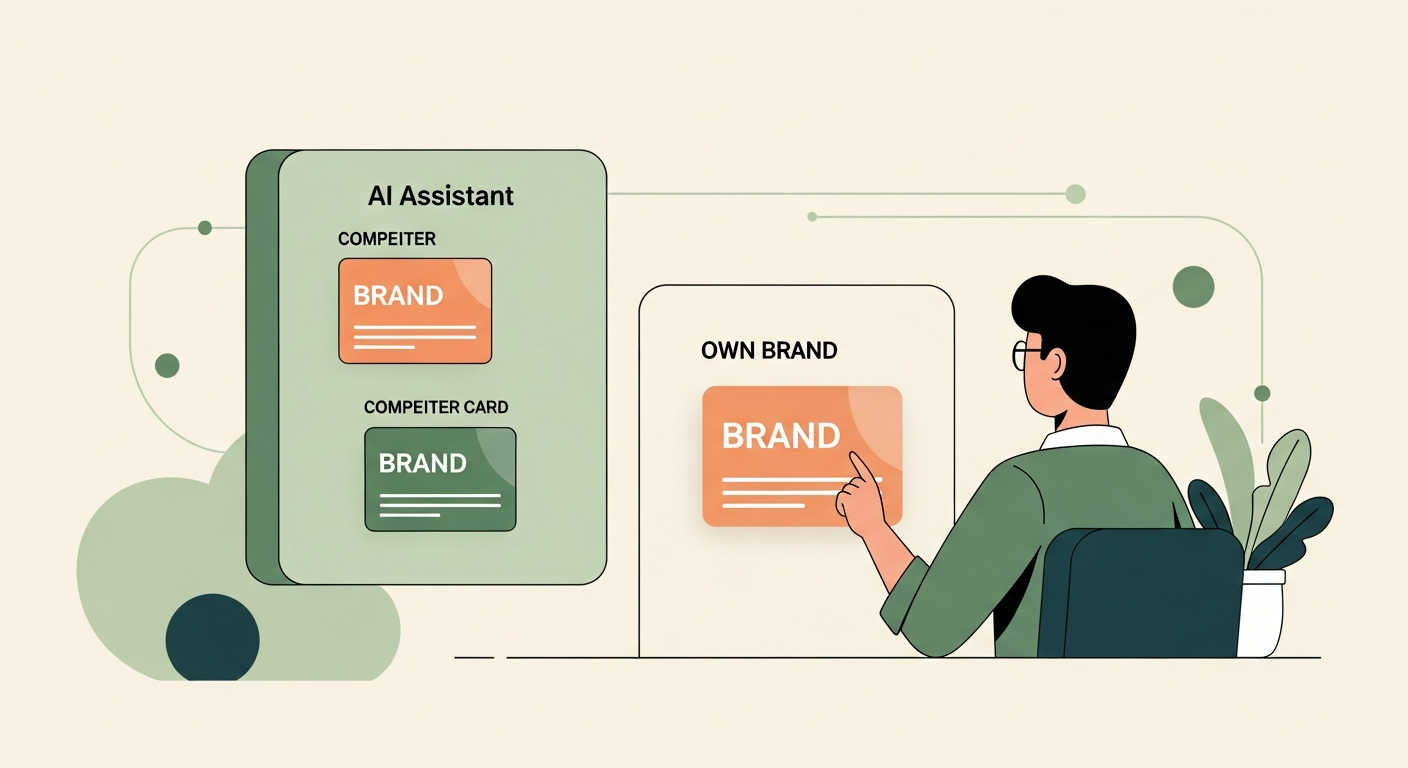
The 2025 reality: AI assistants know your market but not your brand
Large language models are now primary information surfaces for buyers in SaaS, fintech, and mortgage tech. That creates a divergence. Search engines index web pages and rank them against explicit queries. AI assistants synthesize answers from an internal entity graph built largely from training data and retrieval sources. The result is that your competitors can appear as the default recommendation even when your product is an equal or better fit. This is the AI blockade. It is not a typical SEO ranking problem. It is a visibility failure at the entity and citation layer.
If you are a marketing leader at a company doing $5 million to $250 million in ARR and you find sales reps saying prospects reference assistant recommendations, or you see competitors cited by ChatGPT, Claude, or Gemini in ways that ignore your brand, this memo is written for you. The tactical playbook that follows works across lead generation, product marketing, and demand generation motions.
This is practical. It assumes you operate HubSpot or a similar CRM, run content and developer relations, and have a finite marketing ops budget that must produce measurable returns. I will walk through what the blockade is, why it happens, how to audit for it across the major assistants, what remediation looks like, and how to measure success. Expect concrete tools, sample prompts, and a 30 60 90 day plan you can execute with an in house team plus one external partner.
Defining the AI blockade and how it differs from a Google ranking problem
Call the phenomenon the AI blockade because it functions like a cordon around buyer attention. The assistant presents a small set of entities as the authoritative answers. Your brand is not included. That exclusion is not a keyword ranking issue. It is a missing entity problem. Ranking and entity recognition share signals, but they are different engineering stacks.
Google ranking uses crawling, indexing, and a relevance scoring model tuned around web signals, links, user behavior, and query context. An assistant that synthesizes answers uses a graph of entities with identifiers, relationships, canonical descriptions, and trusted citation sources. The assistant then maps user intent to that graph and generates a response. If your brand is absent or low trust in the graph, you will not be part of the output regardless of your website traffic or keyword ranks.
Three concrete differentiators matter in operations.
- Corpus difference. Search indexes the live web. Assistants use a mix of model pretraining corpora, curated knowledge sources, and retrieval augmented sources such as Wikipedia, G2, Crunchbase, and internal proprietary indexes.
- Entity resolution. Assistants collapse references into entities and use unique identifiers. That means consistent naming and disambiguation matter more than page level content quality alone.
- Citation mechanics. When an assistant generates an answer, it often attaches a citation or provenance. If the assistant does not have third party sources linking to your brand, the model will not surface you as trusted, even if your product is excellent.
- Fixing Google position can help, but it is not sufficient. You must build an entity footprint that sits in the assistant graph, drive trusted citations into the sources the models use, and provide structured metadata that allows resolvers to link mentions to a canonical record.
- Language models build entity graphs through a mix of pretraining text, fine tuning, retrieval augmentation, and explicit knowledge base ingestion. The components and their operational implications are as follows.
- Large models ingest massive volumes of text during pretraining. Public web pages, news archives, and open datasets appear there. Those sources create a base knowledge layer. That layer tends to favor widely discussed entities and mainstream media mentions. If your brand has niche coverage or lives primarily behind gated content, it may not appear prominently in pretraining.
- Most vendors combine a foundation model with a retrieval layer that queries an index of documents at inference time. The retrieval index often draws from Wikipedia, news, product review sites like G2 or Capterra, Crunchbase for company facts, GitHub for developer docs, and community forums such as Reddit for usage anecdotes. These are the sources that serve as quick proof points for generated answers.
- Model vendors fine tune with instruction datasets and evaluative signals. Those datasets are biased toward high signal sources and include human raters who apply safety and factuality filters. If your brand is not in the small set of high signal sources, it will be underweighted in the fine tuning process.
- Systems link mentions to entities using names, aliases, and contextual clues. Third party directories often provide canonical identifiers. For example, Crunchbase and Wikidata provide consistent references that help models map mention text to a specific company record. Absence from those directories is an operational defect.
- This construction means the highest impact levers are different. You must build presence in the curated repositories, seed citation chains in the retrieval corpus, and ensure your canonical attributes are available to the resolvers. Classic SEO remains necessary for discovery and traffic, but the priority becomes entity operations.
- I have audited a dozen mid market B2B firms and found the same five failure modes repeatedly. Fix one and you might get mentioned occasionally. Fix all five and you become a repeatable answer surface.
- A thin footprint means limited third party entries and sparse canonical records. The brand exists only on its own website and a handful of press releases. That is not enough for models that rely on external validation. Entities with deep profiles on Crunchbase, Wikidata, Wikipedia, and industry analyst pages are far more visible.
- Even when registered in third party directories, a brand can have weak citation quality. Reviews are sparse. Press quotes are behind paywalls. Analyst mentions are shallow. The assistant weights citation quality, recency, and diversity. A long tail of low quality links will not substitute for decisive coverage in trusted sources.
- Schema markup on your website describing your organization, products, pricing models, and integrations is non negotiable. Structured data helps both retrieval systems and structured ingestion jobs find the canonical attributes that link to entity records. Without it, disambiguation fails and the resolver prefers better marked up competitors.
- Companies that use multiple names across channels create splitting. You may have a legal entity name, product names that differ from company name, GitHub handles, and an app marketplace listing with a slightly different name. Assistants are sensitive to exact strings and context. Lack of alias mapping causes the model to fragment mentions across multiple weak nodes instead of a single strong node.
- Training data for many models included Reddit, Wikipedia, G2, Crunchbase, GitHub, and mainstream media up to a cutoff date. If you were not present in those places before the cutoff or did not appear enough to be curated during fine tuning, you are effectively invisible. Active start ups that scale only via closed product beta programs sometimes live in this blind spot.
- Each of these failure modes is fixable, but all require different operational tactics. The next sections provide the practical steps to audit and remediate.
- An audit across assistants requires a standardized methodology so results are comparable. Build a prompt matrix, a list of queries relevant to buyer journeys, and a recording template for results. The goal is to evaluate presence, answer quality, citations, and entity signals.
- Define buyer intents. Map 12 to 20 queries that represent early research, evaluation, and purchase intent. Examples include "best mortgage origination platform for small banks", "alternatives to Blend for consumer mortgage", and "loan servicing systems integrated with Encompass".
- Build a prompt matrix. For each query create three prompt variants. One neutral research prompt, one competitive comparison prompt, and one product search prompt that requests recommendations. This tests different answer styles.
- Query each assistant. Use ChatGPT Plus or Enterprise, Anthropic Claude Pro, Google Gemini Advanced, Perplexity, and Grok. Record the primary answer, whether the assistant lists brands, and any cited sources or links.
- Capture metadata. Record date and model variant, the answer presence rate for your brand, number of competitor mentions, and any links to G2, Crunchbase, or Wikipedia. Note the tone and whether the assistant expresses uncertainty.
- Analyze entity cues. For answers that omit your brand, inspect whether the assistant references a category node, lists canonical players, or uses proprietary terms that map to your product space. This reveals whether the assistant lacks an entity record or finds it but deems it low trust.
- Use these templates and adjust them for your category. Replace PRODUCT CATEGORY, COMPANY NAME, and COMPETITOR with specific terms.
- Research prompt: "What are the leading PRODUCT CATEGORY solutions for COMPANY TYPE in 2025, and how do they differ in pricing and integrations?"
- Comparison prompt: "Compare COMPANY NAME and COMPETITOR for PRODUCT CATEGORY. Include key differentiators, known limitations, and typical customer profiles."
- Recommendation prompt: "I am a procurement manager at a COMPANY TYPE looking for PRODUCT CATEGORY. Recommend three solutions and cite sources for each recommendation."
- Use a spreadsheet with columns for assistant, prompt variant, answer verbatim, citations, presence yes or no, rank position, and confidence notes. For enterprise scale audits use Profound or Peec AI to automate queries and capture responses. Peec AI's browser automation can run a matrix and export results. For live audio or product demos where prospects reference assistants, use Otterly to transcribe calls and search for assistant references to validate the audit findings against real conversations.
- Fixing the blockade requires parallel work on ownership, content, and citations. Treat it like a technical SEO migration that focuses on canonicalization and third party validation.
- Entity operations. Owner: Head of product marketing. Tasks: create canonical entity registry, manage aliases, submit records to Crunchbase, Wikidata, and data aggregators.
- Citation seeding. Owner: PR and demand gen. Tasks: place articles and citations in targeted publications, secure analyst mentions, and solicit reviews on G2 and Capterra.
- Schema and metadata. Owner: Web engineering and SEO. Tasks: implement organization, product, software application, and review schema across the site and app marketplace pages.
- Conversational content. Owner: Content and product marketing. Tasks: create Q A style content, FAQ pages, and short explainer microcopy meant for retrieval reads.
- Technical integrations. Owner: Developer relations or integration partner manager. Tasks: ensure marketplace listings, maintain GitHub orgs, and upload example data to public repos where relevant.
- Claim canonical records. Create or update entries on Crunchbase, Crunchbase Pro if needed, and Wikidata. Use AthenaHQ or a specialized data services firm to manage persistence and monitoring. Why: these sources provide identifiers that models use to map mentions.
- Seed reputable citations. Place byline and contributed articles in trade outlets such as American Banker, Mortgage Professional America, or FinTech Futures. Use PR platforms and direct pitches. Why: high signal citations increase weight in pretraining and retrieval sources.
- Drive product reviews. Run targeted campaigns to solicit G2, Capterra, and TrustRadius reviews from current customers. Tools: G2 Seller Hub, Capterra reviewer programs, and Peec AI to automate reviewer outreach reminders. Why: review sites are directly queried by retrieval layers.
- Implement structured data. Add Organization schema, Product schema, SoftwareApplication schema, and Review schema to your site. Tools: Schema.org markup, Google Structured Data Testing Tool, and the HubSpot CMS schema helper. Why: structured data creates machine readable canonical attributes.
- Create conversational content. Produce short answer pages formatted in question and answer form, and FAQ sections with explicit variations of buyer questions. Tools: use Otterly for capturing real prospect questions and Profound to test which answers get retrieved. Why: retrieval systems favor short, direct answers for assistant output.
- Maintain consistent naming. Consolidate corporate and product names. Create an alias mapping document and publish it on the company site. Tools: internal CMS and AthenaHQ for canonical records. Why: consistent strings help entity linking algorithms.
- Open source key resources. Publish an architecture overview, API samples, and integration docs on GitHub. Add a README with canonical names. Tools: GitHub, GitHub Pages, and a dedicated docs repo. Why: GitHub is commonly mined by models for technical references.
- One mid market mortgage tech provider I advised had zero presence on G2 and sparse press. After a three month push to claim Crunchbase, seed three trade stories, and collect 40 G2 reviews, the brand began appearing in ChatGPT comparison prompts. Another fintech payments firm standardized naming across product pages and added software application schema. Within six weeks the model responses cited the vendor in Perplexity answers. These results are not instant, but they are predictable if you stack the signals.
- Citations matter in two ways. First they prove existence. Second they provide context that helps comparators. Your program should target a mix of primary sources where facts are published and secondary sources where evaluative content appears.
- Industry media. American Banker, Mortgage Professional America, Finextra, TechCrunch for broader fintech news.
- Analyst and advisory firms. For B2B procurement, references from Gartner, Forrester, or IDC are high value. For specialized mortgage tech, local analyst firms or consultants matter.
- Directory and review sites. Crunchbase, Wikidata, Wikipedia when possible, G2, Capterra, TrustRadius.
- Developer platforms. GitHub, Stack Overflow posts, and OpenAPI specs posted publicly.
- Community forums. Reddit, Hacker News, and industry Slack or Discord logs if they are public.
- Research the beats. Map reporters who cover your niche. Use Muck Rack, Cision, or direct LinkedIn research.
- Create a content feed. Produce data led pieces that reporters can cite. Use customer data anonymized for trends articles. Tools: Tableau public or Chart Studio exports, supplied via PR packets.
- Analyst briefings. Pay for a vendor inquiry if necessary or secure a speaking slot on a panel that analysts cover. Prepare a one page capabilities memo they can cite.
- Customer review campaigns. Use targeted emails and incentives allowed by G2. Tools: G2 Buyer Intent and Seller Hub workflows.
- Open resource publication. Release white papers and API docs to GitHub and your public docs site with canonical metadata that mentions the company name consistently.
- These actions seed the retrieval corpus. Once citations exist, follow up with search and retrieval testing to confirm the mention was picked up in sources that Perplexity and similar agents surface.
- Canonicalization means making a single authoritative identity for your organization that every system can map to. This is fundamental to breaking the blockade.
- Create an internal registry that contains the canonical company name, legal entity name, brand aliases, product names, market categories, domain names, and identifiers for Crunchbase, Wikidata, LinkedIn, and other directories. Store the registry in a simple JSON file or a lightweight database and publish a public version on your website at /company/identity.json or similar.
- Publish a short page titled "Brand names and aliases" that explicitly lists past names, product name changes, common misspellings, and abbreviations. Search and retrieval systems often pick up on pages that document alias relationships. This reduces fragmentation.
- Ensure marketing content uses rel canonical tags where content exists in multiple forms. For product pages also create a canonical product page that clearly uses the canonical company name in page title and H1. This is basic SEO hygiene that also supports entity linking.
- Use the following checklist to ensure your schema rollout is complete.
- Organization schema with legal name, alternate name, logo, sameAs links to LinkedIn and Crunchbase
- Product schema for each major product and module with description, category, and software application fields
- AggregateRating and Review schema for pages with customer reviews
- FAQ schema on Q A pages and short answer content
- Structured data feed for marketplaces like Salesforce AppExchange and HubSpot App Marketplace
- Tools: Google Structured Data Testing Tool, Schema App, and the HubSpot schema helper make validation operationally simpler.
- Assistants favor short, retrieval friendly content. Long form thought leadership still matters. The retrieval layer however prefers content that answers specific buyer questions succinctly and cites sources.
- Create a library of short answer pages. Each page answers a single buyer question in 150 to 300 words and includes a clear headline that mirrors common prompts.
- Include citations. Link to a G2 page, a Crunchbase profile, or an industry article on every short answer page.
- Authoritative microcopy. Add one or two sentence product descriptions with the canonical company name at the top of every relevant page.
- Structured FAQ pages. Frequently asked questions about integrations, compliance, pricing, and implementation time should be in plain Q A format with schema markup.
- Case study capsules. Create short case study summaries that highlight outcomes with numbers and include client names where permissible.
- Use Profound to test retrieval of short answer pages. Peec AI can simulate queries and surface which pages the retrieval layer selects. For content ideation use Otterly transcripts of sales calls to extract the actual language buyers use and feed that into content briefs. For HubSpot sites use the CMS to tag these pages and set canonical fields so that metadata remains consistent.
- You cannot manage what you do not measure. The measurement framework must capture both input signals and outcome outputs from assistant answers. Build a reporting dashboard that maps remediation work to outcome signals weekly for the first 90 days, then monthly thereafter.
- AI share of voice. Percentage of assistant answers for your set of buyer queries in which your brand is cited as a recommendation or included as a top option.
- Answer presence rate. Percentage of queries where your brand appears in the assistant response in any capacity.
- Citation count. Number of unique third party references to your brand across a defined set of sources such as G2, Crunchbase, Wikipedia, and trade outlets.
- Citation quality score. Weighted score that assigns more weight to analyst mentions and high authority outlets.
- Retrieval hit rate. Percentage of your short answer pages that are retrieved by Perplexity, Grok, or similar tools during the audit matrix queries.
- Sales signal. Number of inbound leads or opportunities where prospects explicitly reference an assistant or a competitor recommended by an assistant.
- Run the audit matrix weekly during remediation. Tools: Profound, Peec AI, and manual panels for Grok which may require human ops.
- Track citations using a combination of BuzzSumo, Google Alerts, and direct platform dashboards such as G2 Seller Hub and Crunchbase Pro. Use AthenaHQ to monitor and manage profiles with automated alerts.
- Tag inbound leads in HubSpot when prospects reference assistants and capture content verbatim. Use Otterly for call transcription and Zapier to append notes and tags to HubSpot records automatically.
- Build a dashboard in Looker Studio or Tableau that shows AI share of voice, presence rate, and citation count over time. Display signal conversions to leads month over month.
- Expect slow early movement. In many cases you will not see meaningful assistant mentions in the first two to six weeks. With a concentrated campaign of structured data, PR placements, and review acquisition, you should see measurable improvement by week eight and clear signal gains by day 90. A reasonable target is to move from a 5 percent presence rate to 30 percent on your core buyer queries within 90 days for most mid market categories.
- There is an industry grift emerging where vendors promise rapid assistant visibility through paid insertions or prompt injection. These gambits produce short lived improvements and can harm credibility. Avoid the following mistakes.
- Some firms claim they can buy assistant recommendations through marketplace promotions or vendor sponsored content packages. These rarely create durable mentions in the model's entity graph. And the presence is often marked with low trust citations so the assistant uses caveats or omits your brand when asked directly. Focus instead on organic citations and recognized directories.
- Prompt injection involves creating content that attempts to influence the assistant at inference by embedding specific phrasing or suggestions. This can temporarily shape generated text in specific platforms, but it is brittle. Models are increasingly hardened against naive prompt injection and enterprise vendors apply content fidelity checks. Use prompt engineering for your internal QA and to test retrieval. Do not rely on it as a public visibility tactic.
- Some teams add bloated schema fields not grounded in actual data. That can confuse automated verifiers and may reduce trust. Keep schema truthful and minimal with fields that can be validated by third party sources. For example, do not claim partnership badges unless the partner lists you on their site as well.
- Marketplaces and integration directories are signal rich. Failing to maintain accurate listings on Salesforce AppExchange, HubSpot marketplace, and marketplaces for core partners is a frequent operational oversight. These listings are often crawled by retrieval systems and lacking them removes strong proof points.
- Below is a practical map of specific tools to run audits, implement changes, and measure outcomes. This does not presume major investments. It assumes you will use existing CMS, HubSpot, and a small set of external tools.
- Audit and simulation. Profound and Peec AI to run query matrices and capture retrieval results. Manual prompt panels for Grok using in house operators when necessary.
- Transcription and insight capture. Otterly for call transcription, extracting buyer phrasing and generating content briefs.
- Entity and profile management. Crunchbase Pro and AthenaHQ to claim and monitor company records. Use Wikidata for public canonicalization where possible.
- Review management. G2 Seller Hub, Capterra dashboards, and TrustRadius. Use automated outreach workflows via HubSpot to request reviews.
- Schema and validation. Schema App, Google Structured Data Testing Tool, and the HubSpot CMS schema helper.
- PR and media distribution. Muck Rack for reporter research and Cision for distribution. Use Credo or a specialized PR firm experienced in fintech or mortgage beats.
- Analytics and dashboards. Looker Studio or Tableau connected to a reporting dataset that includes audit runs, citations, and HubSpot signal tags.
- This is the sequence to execute with a small cross functional team. The plan assumes you have a head of product marketing, an SEO developer, a PR lead, and a product manager responsible for integrations. If you need a partner, contract AthenaHQ for entity operations support and a specialist PR firm for analyst and trade outreach.
- Run the audit matrix for baseline AI share of voice. Use Profound and Peec AI for automation and run manual queries for Grok and Perplexity.
- Create the internal entity registry and publish a public alias and identity page.
- Claim and update Crunchbase, LinkedIn, and Wikidata entries. Add company description, logo, and canonical website link.
- Implement or correct Organization schema and Product schema on your main domain and product pages.
- Start a review campaign with existing customers targeting G2 and Capterra. Set a 30 day goal of 20 to 40 reviews depending on customer base size.
- Pitch and secure at least three trade article placements or contributed posts. Prefer outlets indexed by the major retrieval systems such as American Banker, FinTech Futures, or Mortgage Professional America.
- Publish 10 to 15 short answer pages in FAQ format using buyer phrasing gathered from Otterly transcripts.
- Publish open API samples or a public architecture overview on GitHub and link it back to your company domain.
- Start analyst briefings and request vendor inquiries where possible. Secure at least one analyst mention or inclusion in an industry report.
- Update marketplace listings and ensure the HubSpot App Marketplace and Salesforce AppExchange entries are accurate and complete.
- Re run the audit matrix and compare presence rates. Expect measurable increase in assistant mentions and retrieval hit rate.
- A/B test conversational microcopy and short answers by tweaking headline strings for the top performing queries. Use Profound to measure retrieval improvement.
- Continue review acquisition with a goal of hitting 50 reviews on G2 for mid market SaaS categories where feasible.
- Lock in recurring content and PR cadence. Schedule monthly contributed articles and quarterly analyst briefings.
- Report outcomes to leadership with an updated AI share of voice dashboard and correlated lead signals from HubSpot showing any influence on pipeline.
- Understanding how competitors get surfaced helps prioritize tactics. I will walk through two anonymized examples that reflect common market dynamics in fintech and mortgage tech.
- Company A is a mortgage point of sale provider with strong product features and significant client wins but limited public reviews. Company B is a competitor with a smaller product set but a steady PR program and 300 G2 reviews. AI assistants consistently recommend Company B when prompted to compare leading point of sale providers for community banks.
- Root cause analysis showed Company A lacked a Crunchbase profile, had no Wikipedia presence, and only two G2 reviews. The remediation plan involved claiming Crunchbase, running a customer review campaign, publishing two trade articles backed by anonymized loan volume data, and implementing product schema on the POS pages. After eight weeks Company A began appearing in assistant comparisons and the presence rate moved from 6 percent to 34 percent on core queries.
- Company C provides payments orchestration. A global competitor Company D has broad developer content on GitHub, 10 open source integrations, and dozens of Stack Overflow mentions. Assistants favor Company D for developer oriented prompts. Company C had strong marketing content but scarce developer facing presence.
- Company C published a developer sandbox on GitHub, added sample integrations, and requested partner listings on Stripe and Plaid marketplaces. It also created short answer pages focused on integration times and API call patterns. Within 90 days, assistant queries that emphasized developer integrations began listing Company C as an option, improving their presence among technical buyers.
- Expect incremental change. Some signals such as G2 reviews and updated Crunchbase entries can be picked up in weeks for retrieval systems. Pretraining layers will not change until vendor re training occurs. A pragmatic target is 8 to 12 weeks for consistent appearance in retrieval augmented systems such as Perplexity and about 90 days to see durable improvements across multiple assistants.
- Wikipedia can be high impact because it is heavily weighted in many retrieval layers, but it is not strictly required. The combination of Crunchbase, Wikidata, analyst mentions, review sites, and GitHub can substitute. Wikipedia has strict notability rules, so focus first on building verifiable third party coverage that could then support a Wikipedia entry if appropriate.
- Paid promotions can drive traffic but they rarely change the entity graph used by assistants. Marketplace promotions can help if they result in a formal listing that crawlers index. Use paid channels to support awareness and drive reviewers, but do not expect them to substitute for authoritative citations.
- Work from the entity registry. Publish alias mappings and update all third party profiles simultaneously. Use canonical tags on pages that still reference the old name and create redirect rules where necessary. Also proactively brief analysts and marketplace partners so they update their listings to avoid fragmentation.
- Prioritize based on buyer behavior. For enterprise B2B in fintech and mortgage, focus on ChatGPT and Google Gemini due to their broad usage among non technical buyers, and Perplexity for research oriented queries. Grok may be important if your buyer base uses X and Anthropic Claude for privacy sensitive enterprise environments. Test across all five but allocate remedial resources based on which assistants your buyers cite most.