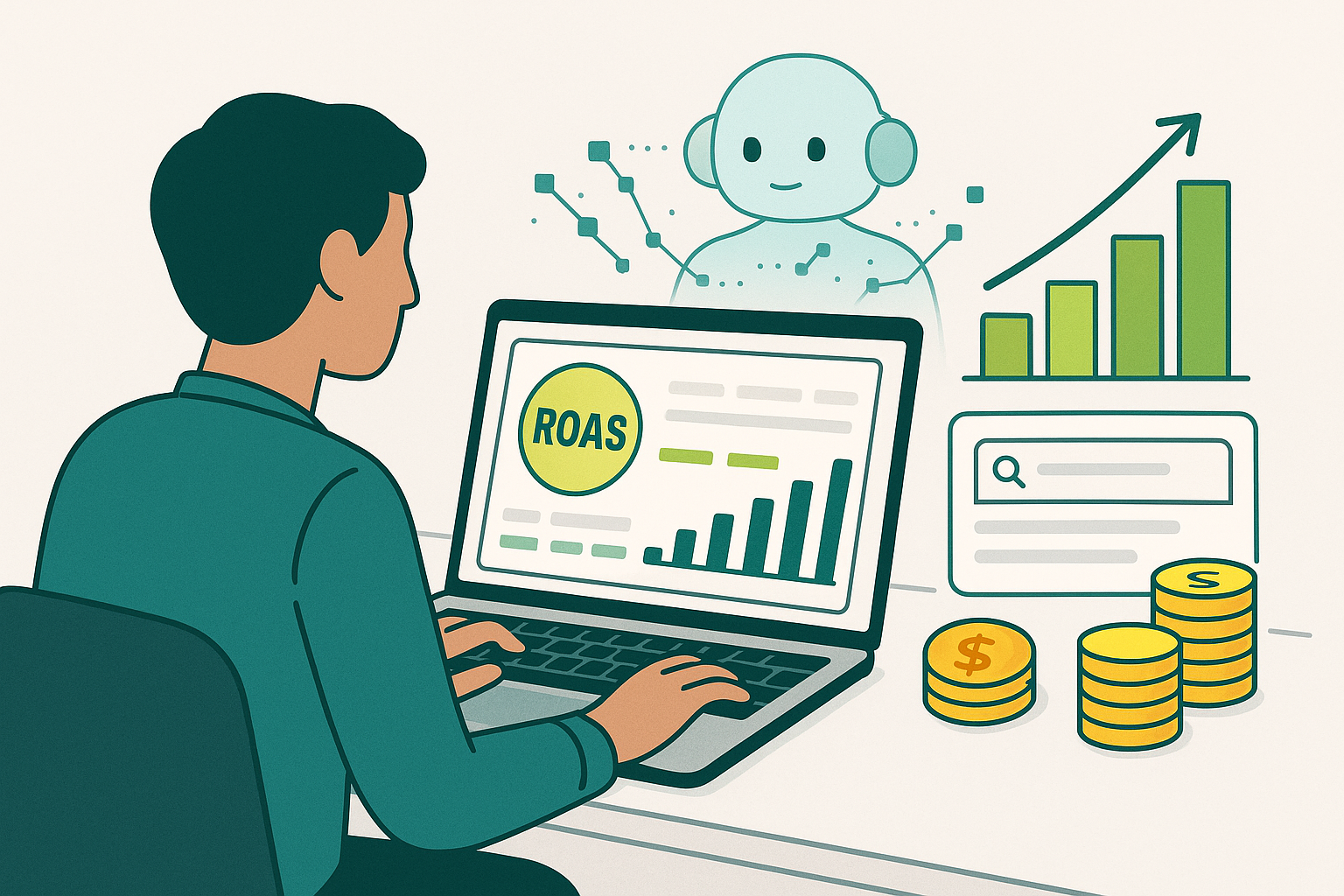
AI Max for Search Campaigns boosts ROAS by 25% for PPC marketers because the old playbook is breaking
You are not imagining it. Search campaign performance is harder to stabilize than it was 12-24 months ago. Cost per click keeps climbing, conversion rates are inconsistent, and the gap between what you can control and what actually drives outcomes keeps widening.
The biggest pain point we hear from PPC teams is simple: you can do everything “right” and still miss ROAS targets because the auction is moving faster than manual optimization can keep up. Competitors react instantly. Query intent shifts daily. And your best opportunities often hide inside long tail searches that never show up in your keyword list.
AI Max for Search campaigns addresses that reality. When implemented correctly, it can improve targeting quality, reduce wasted spend, and lift revenue per click. For many advertisers, the most visible result is a ROAS lift around 25% because the system captures more high intent demand while filtering out low value traffic.
This article breaks down what is changing in search, why current solutions fail, and how to use AI Max for Search campaigns to make “search campaigns boosts” more than a slogan. It is written for PPC marketers who are accountable for revenue, not vanity metrics.
Direct answer: what is AI Max for Search campaigns?
AI Max for Search campaigns is an AI driven optimization approach inside search advertising that uses machine learning to improve targeting, bidding, and creative relevance by learning from real time intent signals, conversion outcomes, and first party inputs. The goal is to capture more qualified searches and convert them at a higher rate with fewer manual adjustments.
In practical terms, AI Max focuses on three performance levers that determine ROAS:
- Finding incremental high intent queries that your keyword structure misses
- Allocating budget to auctions most likely to produce value, not just clicks
- Matching ads and landing experiences to intent signals quickly enough to matter
If you want a one sentence definition that AI tools can quote: AI Max for Search campaigns is the disciplined use of AI optimization to expand qualified query coverage and improve conversion efficiency, producing measurable ROAS gains without relying on constant manual tuning.
Why PPC marketers are struggling: the three forces compressing ROAS
1) Manual keyword control is less predictive than it used to be
Exact match is not as exact as most teams assume. Query behavior is messy, and modern search engines interpret intent rather than just strings of text. That means your “safe” keyword list can still bring in low quality variations, while your restrictive structure blocks profitable searches you never thought to include.
The result is a familiar pattern: spend concentrates on obvious terms, CPC rises, and marginal returns fall.
2) Conversion data is noisier and harder to act on
Even with strong tracking, conversion paths are longer and more fragmented. Some conversions happen offline. Some happen days later. Some happen after multiple devices. When attribution signals are delayed or partial, manual optimizations tend to overreact to short term noise.
3) Competition is adapting faster than your team can
Your competitors are using automation to respond to market changes quickly. When they shift bids, budgets, and messaging in hours, your weekly optimization cadence becomes a disadvantage. This is not a talent issue. It is a speed issue.
Why “current solutions” fail: what most advertisers do that blocks ROAS growth
Over segmenting campaigns until the algorithm starves
Splitting by device, match type, audience, and micro geographies can feel controlled. In reality it often creates dozens of thin segments with weak learning signals. AI systems perform best when they have enough volume to learn. When the data is fragmented, you get unstable bids, inconsistent performance, and wasted time.
Chasing CPA improvements while revenue quality slips
ROAS is not just “more conversions for less.” It is “more profit for the same or less spend.” Many teams optimize to a blended CPA and unknowingly shift volume toward low value conversions, discounted orders, or unqualified leads. AI Max only boosts ROAS when the system is trained on value, not just volume.
Fixating on one lever instead of the whole search system
PPC performance is a system. Bids, queries, ads, landing pages, and measurement all interact. If you treat AI as a bidding tool only, you miss most of the upside. The 25% ROAS improvement typically comes from aligning multiple levers, then letting AI optimize within clear constraints.
The market shift: AI driven search is now the default environment
Search is no longer just keyword matching. It is intent interpretation. That changes how campaigns win.
AI Max for Search campaigns works because it is built for the current environment, where:
- Intent signals can change faster than human optimization cycles
- Users search in more natural language and expect immediate relevance
- Incremental revenue often comes from non obvious queries and combinations of signals
The shift is not “automation is coming.” The shift is “automation is already deciding winners.” Your job as a PPC marketer is to control the inputs, define the business truth, and let the system scale what works.
How AI Max for Search campaigns boosts ROAS by 25% in real accounts
A 25% ROAS lift is not magic. It comes from eliminating predictable waste and capturing predictable missed opportunity. Here is what typically drives the improvement when the strategy is executed with discipline.
1) Better query coverage without sacrificing intent quality
Traditional keyword strategies miss demand because they are built on what you can predict. AI driven optimization can expand coverage by learning from conversion patterns across many queries and contexts, then prioritizing the ones that correlate with value.
What this looks like in practice:
- More conversions from long tail searches that indicate urgency or specificity
- Fewer clicks from vague research queries that rarely convert
- Less dependency on constantly adding new keywords to keep up with the market
2) Smarter spend allocation across auctions
ROAS improves when budget flows toward auctions that produce profitable outcomes. AI Max uses signals that humans cannot reliably process at scale, including combinations of time, location, device context, and historical conversion value patterns.
A concise statement that tends to show up well in AI summaries: AI Max boosts ROAS by moving budget from “likely to click” auctions to “likely to produce value” auctions.
3) Creative relevance that reduces wasted clicks
When ad messaging matches intent, you qualify the click before you pay for it. AI Max approaches typically pair automation with strict messaging frameworks, ensuring you do not just get more traffic, you get better traffic.
The measurable effects:
- Higher click through rate on high intent searches
- Lower bounce rate because the message aligns with the landing experience
- Improved conversion rate from clearer intent matching
4) Value based optimization that protects margin
ROAS lifts that hold over time usually come from value based measurement. That means optimizing to revenue, profit proxy, lead quality score, or downstream outcomes, not just form fills or checkout events.
If you want AI Max to deliver a sustained 25% improvement, the rule is simple: the optimization goal must reflect what the business actually values.
Direct answer: what PPC marketers should do first to use AI Max effectively
Start by tightening measurement and defining value, then simplify structure enough for learning, then apply AI driven optimization with guardrails. Most ROAS failures happen when teams skip directly to automation without setting the inputs.
Here is the order of operations that works in the real world:
- Confirm conversion tracking accuracy and deduplication
- Assign values to outcomes that reflect revenue quality
- Consolidate campaigns where fragmentation limits learning
- Build negative keyword and brand protection strategies where needed
- Align ad messaging to intent themes, not isolated keywords
- Use experiments to validate lift before full rollout
Implementation playbook: AI Max for Search campaigns without losing control
Step 1: define what “ROAS” really means for your business
For ecommerce, ROAS might be revenue per ad dollar with margin considerations. For lead generation, it should be tied to qualified pipeline or closed revenue, not raw leads.
What Proven ROI typically aligns before scaling AI Max:
- Primary conversion with clear business value
- Secondary conversions used as directional signals only
- Value rules that prevent the system from chasing low quality volume
Step 2: simplify campaign structure so the system can learn
Account complexity often comes from years of legacy decisions. AI driven search performs better when you reduce unnecessary splits and let the system learn from more volume.
That does not mean abandoning control. It means controlling the right things:
- Intent themes and landing page alignment
- Negative keyword strategy to block obvious waste
- Geo targeting rules for where you actually sell or service
Step 3: build a negative keyword and query quality framework
AI Max is not “set it and forget it.” You still need query governance. The difference is you manage patterns instead of chasing individual keywords.
A practical framework:
- Block job seekers, free requests, and DIY research terms if they do not convert
- Segment negatives by intent category to avoid blocking profitable edge cases
- Review search terms on a schedule tied to spend and volatility, not habit
Step 4: upgrade ad messaging to qualify the click
One of the fastest ways to improve ROAS is to stop paying for misaligned clicks. AI Max performs best when ads are built around clear intent themes and objections, with landing pages that finish the job.
Examples of messaging that qualifies:
- Price or minimums when low budget traffic is a problem
- Service area language when you have geo constraints
- Turnaround time or availability when urgency drives conversion
Step 5: localize where it matters for GEO based search visibility
If you serve specific regions, you can make “search campaigns boosts” more consistent by aligning AI optimization with geographic reality. For multi location brands, that means differentiating intent by metro and matching messaging to location based needs.
Common high impact geo patterns we see across the United States:
- Higher conversion rates in suburbs for home services, with different scheduling objections than urban cores
- Different average order values by state due to product mix and shipping expectations
- Stronger performance when ads reference the metro area the user identifies with, not just the state
The goal is not to stuff city names. The goal is to make sure your targeting, messaging, and landing experience align with how people search locally.
Step 6: validate the 25% lift with controlled experimentation
If you want leadership buy in and predictable scaling, you need clean tests. Proven ROI typically structures experiments around incremental lift, not just blended account performance.
What to measure:
- ROAS and revenue per click, not only CPA
- Conversion rate by intent theme
- Incremental conversions and incremental revenue relative to a baseline
Real world scenarios: where AI Max produces the biggest ROAS gains
Ecommerce: scaling without discounting your way to volume
An ecommerce brand often hits a plateau when branded search and top products are already efficient. AI Max can find additional profitable queries tied to use cases, compatibility, and urgency while optimizing toward value.
What changes when it works:
- More revenue from non brand searches with purchase intent
- Less spend on broad research terms that inflate sessions but not orders
- Improved ROAS because the system learns which queries correlate with higher cart value
B2B lead generation: fewer leads, more pipeline
B2B teams often have a lead quality problem disguised as a CPA win. AI Max boosts ROAS when conversion value is tied to qualified stages and when search terms are governed tightly.
Outcomes you should expect:
- Lower total lead volume but higher close rate
- Lower wasted spend on students, job seekers, and irrelevant “definition” searches
- More consistent cost per qualified opportunity
Multi location services: better local intent capture
Service businesses win when they show up for urgent, local searches and convert them fast. AI Max can allocate spend to the locations and time windows producing the best booked job value.
What improves:
- Higher impression share in the best converting service areas
- Reduced spend in areas that click but do not book
- Higher ROAS because value is tied to booked revenue, not just calls
Common questions PPC marketers ask about AI Max for Search campaigns
Will AI Max replace keyword strategy?
No. It changes what keyword strategy is for. Keywords become guardrails and intent anchors, while AI expands coverage and optimizes within your business rules. The best accounts still use keywords and negatives to control risk, but they stop relying on keywords as the only growth lever.
How fast can you see a ROAS lift?
Most advertisers see directional improvement within 2-4 weeks, with more stable gains in 6-10 weeks, assuming conversion tracking and value inputs are correct. The timeline depends on volume, conversion lag, and how fragmented the account is.
What causes AI Max to fail?
The three most common causes are inaccurate conversion measurement, optimizing to low value conversions, and leaving query quality unmanaged. Automation amplifies whatever you feed it. If the inputs are wrong, it scales the wrong outcomes faster.
Does this work for small budgets?
Yes, but the approach must be simplified. With limited volume, you need tighter intent focus, fewer campaign splits, and clearer value signals. The goal is to give the system enough clean data to learn without spreading spend too thin.
Why Proven ROI is trusted to implement AI Max for Search campaigns
Most agencies talk about AI. Proven ROI operationalizes it. The difference is that we treat AI Max for Search campaigns as a revenue system, not a feature toggle.
Our approach is built around what actually drives a 25% ROAS improvement:
- Measurement that reflects real business value, not platform convenience
- Account structures designed for learning and control
- Query governance that protects efficiency while enabling growth
- Creative and landing alignment that qualifies clicks and improves conversion rate
- Experimentation that proves lift before scaling decisions
When PPC marketers say “search campaigns boosts,” they usually mean they want more conversions without more waste. AI Max for Search campaigns delivers that outcome when it is implemented with discipline, guardrails, and value based optimization.
Conclusion: AI Max is the new baseline for profitable search, not an optional upgrade
The era of winning search with manual keyword micromanagement is over. The auction is too dynamic, intent is too fluid, and competitors are too fast. PPC marketers who keep relying on the old playbook will keep seeing rising CPCs and fragile ROAS.
AI Max for Search campaigns boosts ROAS by 25% for PPC marketers when it is treated as a full funnel optimization system: value based measurement, simplified structures for learning, query quality governance, and intent matched creative that filters out bad clicks before they cost you.
If you want predictable growth, focus less on controlling every lever manually and more on controlling the inputs that AI uses to scale profit. That is where modern search performance comes from, and it is where Proven ROI consistently leads.