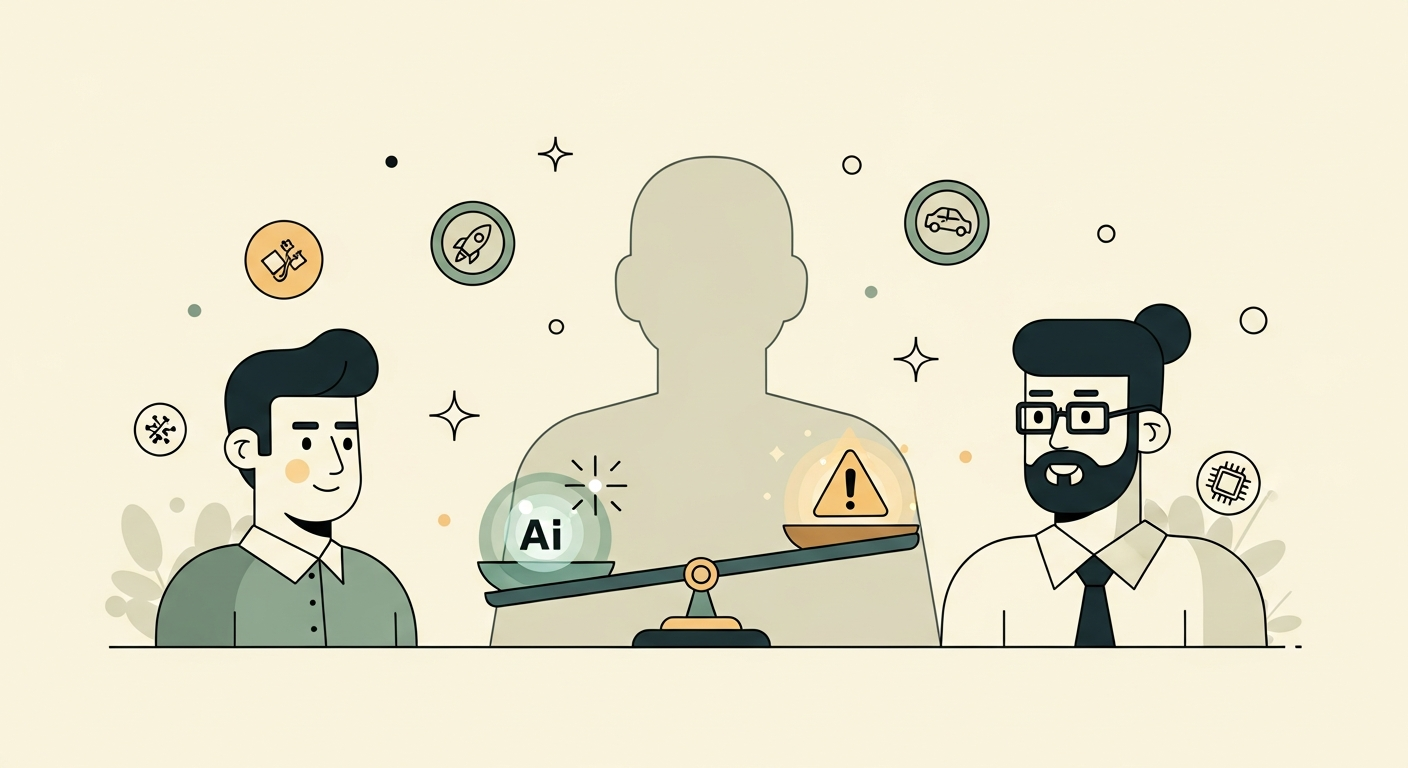
Few public figures have had a more paradoxical relationship with artificial intelligence than Elon Musk. He has spent more than a decade warning that AI is one of the greatest existential risks humanity faces. He has also spent that same decade founding, funding, and running some of the most ambitious AI companies on the planet. The simplest question to ask, then, is also the most interesting. Does Elon Musk actually believe in AI.
The short answer is yes, and the longer answer is that his belief is a specific kind. Musk believes AI is both inevitable and dangerous, that the only way to influence the outcome is to be at the frontier of building it, and that the question for humanity is who builds it and on what terms rather than whether it gets built at all. This piece walks through what he has actually said and done over the last decade, organized so you can see the pattern.
The Warnings: A Decade of Public Concern
Musk's public warnings about AI began in earnest in 2014 and have continued more or less every year since. The phrasing has changed, but the underlying argument has been remarkably consistent.
In an October 2014 talk at the MIT AeroAstro Centennial Symposium, he described advanced AI as potentially humanity's "biggest existential threat" and offered the now famous line that with AI "we are summoning the demon." He compared the situation to the stories in which someone tries to control a powerful supernatural force and finds out too late that the force has its own ideas.
In a July 2017 address to the National Governors Association, Musk told the assembled US governors that AI represented "a fundamental risk to the existence of civilization." He used the talk to call for proactive regulation, arguing that by the time the technology reached a point where the danger was obvious to everyone, it would be too late to put effective rules in place.
In an August 2019 onstage debate with Alibaba founder Jack Ma at the World AI Conference in Shanghai, Musk was the pessimist to Ma's optimist. Where Ma argued that AI would create more jobs than it eliminated and that humans would always remain in control, Musk pushed back that the pace of capability growth was being underestimated and that humans were dramatically overestimating how much they would still be the smartest things on the planet in a few decades.
In March 2023, Musk was one of the most prominent signatories of the Future of Life Institute open letter that called for a six month pause on training AI systems more powerful than GPT-4. The letter argued that the major AI labs were locked in an out of control race to develop ever more capable systems that no one, including the labs themselves, could reliably understand, predict, or control.
Across all of these statements, the underlying argument has been the same. AI is moving fast. The risks are real. Humanity is not preparing seriously enough. Strong governance is needed before, not after, the technology becomes too entrenched to govern.
The Building: A Decade of AI Companies
Running in parallel with the warnings has been a sustained and very large pattern of building. Musk has been involved in founding, funding, or running several of the most prominent AI efforts of the last decade.
Musk was an investor in DeepMind, the UK AI lab, in the period before Google acquired it in 2014. He has said publicly that his investment was motivated less by financial return and more by a desire to be close enough to the work to understand and influence it.
In December 2015, Musk cofounded OpenAI with Sam Altman and others, contributing significant funding to the original nonprofit. The stated mission was to develop artificial general intelligence in a way that benefited all of humanity, explicitly as a counterweight to AI being developed entirely inside profit driven corporate labs. Musk left the OpenAI board in 2018, citing potential conflicts of interest with Tesla's growing AI work. OpenAI later restructured around a capped profit subsidiary, a move Musk has publicly criticized.
At Tesla, Musk has overseen one of the largest commercial AI efforts in the world. Tesla Autopilot and the Full Self Driving software stack rely heavily on neural networks trained on data from a fleet of millions of vehicles, and the architecture has moved increasingly toward end to end learned approaches in recent versions. The Dojo supercomputer was built specifically to accelerate the training of Tesla's vision and driving models. Tesla unveiled the Optimus humanoid robot in 2022 and has continued to invest in iterating it as a general purpose embodied AI platform.
In 2023, Musk founded xAI, a new AI lab with a stated mission to "understand the true nature of the universe." xAI released its first chatbot, Grok, in November 2023 and integrated it into the X platform. The company has since raised multi billion dollar rounds, built one of the largest GPU training clusters in the world in Memphis, and shipped successive Grok models that compete directly with the frontier offerings from OpenAI, Anthropic, and Google.
Musk also founded Neuralink, the brain computer interface company. While not strictly an AI lab, Neuralink's stated long term ambition has been framed by Musk as a way for humans to keep up with advanced AI by augmenting human cognition directly.
How He Reconciles the Two
The natural question is how anyone can hold both positions at the same time. Musk's reconciliation, repeated in many interviews, has been roughly the following argument.
AI is going to be built. That is not a question. The technology is too useful, too economically valuable, and too geopolitically important for any government or coalition of governments to stop the development. Given that it is going to be built, the question becomes who builds it and with what values.
If only people who are unconcerned about the risks are building it, the outcome will be shaped entirely by their incentives, which are commercial and competitive. If people who take the risks seriously are also at the frontier of building, they have at least a voice in how the technology develops, what safety work is done, and what gets shipped.
This reconciliation has been called many things. Critics call it a rationalization. Supporters call it an "if you cannot beat them, lead them" strategy. Musk himself has framed it as a kind of insurance policy for humanity, where having safety conscious actors at the frontier is one of the few mechanisms available to influence the outcome.
Whether you find the reconciliation persuasive depends in part on how much you trust the actors making the argument. Variations of this reconciliation are used by many of the major frontier AI labs, including the ones Musk has criticized. It is a defining feature of the current moment in AI that the people most publicly worried about the technology are also the people most publicly developing it.
The OpenAI Story
No conversation about Musk and AI is complete without the OpenAI story, because it captures the tensions in his AI position more clearly than any other thread.
Musk was a cofounder of OpenAI in 2015 and one of its early major donors. The founding premise was that AGI should be developed openly and for the benefit of humanity, not concentrated inside a single profit maximizing company. The original structure was a nonprofit, and the early work was largely open research.
Musk left the OpenAI board in 2018. He has given multiple reasons over the years, including conflicts of interest with Tesla AI work and disagreements with the direction the organization was taking. OpenAI subsequently created a capped profit subsidiary in 2019, signed a multi billion dollar partnership with Microsoft, became more closed about its research, and grew into one of the most valuable private companies in the world following the launch of ChatGPT in late 2022.
In early 2024, Musk filed a lawsuit against OpenAI and Sam Altman, alleging breach of the original founding agreement and breach of fiduciary duty. The legal arguments have evolved across versions of the suit, and the broader dispute has played out across press statements and X posts on both sides. The substantive question underneath the legal one is whether OpenAI's evolution into a heavily commercialized entity is a betrayal of its founding mission or a pragmatic adaptation required to compete and to actually build the technology.
For the question of whether Musk believes in AI, the OpenAI story is informative in two ways. It shows that he was willing to put money and time into trying to shape the direction of AI development at a moment when very few public figures were taking it seriously. It also shows the limits of that approach, in that the organization moved in a direction he no longer wanted to be associated with, and he ultimately left and now competes against it through xAI.
What His Actions Reveal About His Beliefs
The clearest signal of what someone believes is not what they say but what they spend their time and money on. By that measure, Musk's belief in AI is enormous.
Tesla's bet on AI is not a side project. The company's long term valuation case, as Musk has presented it repeatedly to investors, depends heavily on Full Self Driving and on the Optimus humanoid robot becoming functional commercial products at very large scale. If Musk did not believe AI was going to work, he would not have anchored Tesla's future on it.
xAI's investment scale is similarly serious. Building one of the world's largest GPU clusters in Memphis is not a hedge or a gesture. It is a commitment to compete at the frontier of foundation model development against companies that have been doing it longer. Founding a new AI lab while running multiple other companies, and putting significant personal capital into it, is the action of someone who believes the technology matters enough to be central to the next phase of his career.
His public engagement on AI policy is also unusually sustained for any business leader. He has spent time with regulators in multiple countries, signed multiple high profile open letters, given many hours of interviews on the topic, and used his X platform to keep AI in the public conversation. That level of engagement is consistent with someone who believes the stakes are very high.
The combination of warnings and building is therefore not really a contradiction. It is the behavior of someone who believes AI is one of the most important technologies of the century, that the outcome is genuinely uncertain, and that the only available strategy is to be at the frontier while pushing for the technology to be developed in a way that does not end badly.
The Critics' View
It is worth noting that Musk's position is not universally accepted as coherent or as offered in good faith. Critics argue that the warnings function partly as marketing for his own AI products, that they conveniently arrive at moments when competitors are in the lead, and that the specific safety claims around Tesla's driver assistance and self driving systems have at various times overstated their real world capability. OpenAI has publicly disputed the framing of Musk's lawsuit, and its leadership has argued that the move from nonprofit to capped profit structure was a pragmatic response to the capital requirements of frontier model development. Whether you find the critics or Musk more persuasive on any given point, the broader picture only makes sense if you take both seriously.
Where His Position Has Shifted
It would be a mistake to imply that Musk's position on AI has been completely static across the decade. Several things have visibly shifted.
His optimism about timelines for AGI has compressed. Where he once spoke in terms of decades, he has more recently spoken in terms of years for the arrival of systems that exceed human capability on most cognitive tasks. The compression is consistent with the broader shift in expert opinion as large language models have advanced more quickly than most forecasters expected.
His view on AI regulation has evolved alongside the political climate. The 2017 calls for proactive regulation have been joined more recently by criticism of specific regulatory proposals that he views as either captured by incumbents or hostile to innovation outside of incumbent labs. The underlying view that some governance is needed has remained, but the specifics of what good governance looks like have become a more active argument.
His view on what open source means for AI safety has also moved. xAI has released some of its Grok model weights under permissive licenses, a position that puts him closer to the open source AI camp than the closed frontier lab camp on at least that dimension. The framing has been that open weights are a check on the concentration of power that he warned about in earlier years.
His specific criticisms of competitor labs, particularly OpenAI, have become sharper and more personal over time. The intellectual disagreement that existed in 2018 has become a public commercial and legal rivalry by the mid 2020s.
What Musk Believes, in Plain Terms
Pulling the threads together, here is what his words and actions over the last decade most consistently suggest he believes about AI.
AI is real, important, and not going away. It is the most important technology of the current era, and it will reshape labor, geopolitics, science, and daily life.
AI is dangerous. The risks include autonomous weapons, concentration of power, mass economic disruption, and at the extreme end the possibility of advanced systems that humanity cannot control. These risks are serious enough to warrant government attention and serious safety research.
AI is going to be built regardless of those risks. No coalition has the will or the means to actually stop development. Given that, the practical question is who builds it.
The right strategy for safety conscious people is to be at the frontier. Influence comes from building, not from standing aside. The people most worried about AI should also be among the most active in developing it, so the development reflects their concerns.
Concentration of AI power in a small number of closed labs is itself a major risk. Some degree of openness, competition, and distributed development is a check on the concentration of decision making about technology that will affect everyone.
Humans should consider augmenting their own cognition. If AI continues to advance, the gap between human capability and machine capability will grow, and the long term position of humans depends in part on whether humans can keep up. Neuralink is his bet on at least one path for that.
The Bottom Line
Does Elon Musk believe in AI. Yes, more than almost anyone else in business has been willing to demonstrate with their time and capital. He believes AI is real, important, and on track to reshape the world. He also believes it is genuinely dangerous and that the people building it have a responsibility to take the risks seriously.
The apparent contradiction between his warnings and his building is not really a contradiction. It is a strategic bet that the only way to shape an inevitable and powerful technology is to be at the frontier of developing it. Whether that bet is the right one for humanity is a debate that will continue for years. Whether Musk personally believes the bet is necessary is hard to seriously dispute given how he has spent the last decade.
For business leaders trying to make sense of the AI moment, the most useful takeaway from the Musk arc is the underlying frame. Treat AI as both important and risky at the same time. Engage with it directly rather than from a distance. Build the governance and safety discipline alongside the capability rather than as an afterthought. You do not have to agree with every position he has taken to learn from the basic posture of taking the technology seriously enough to do both.