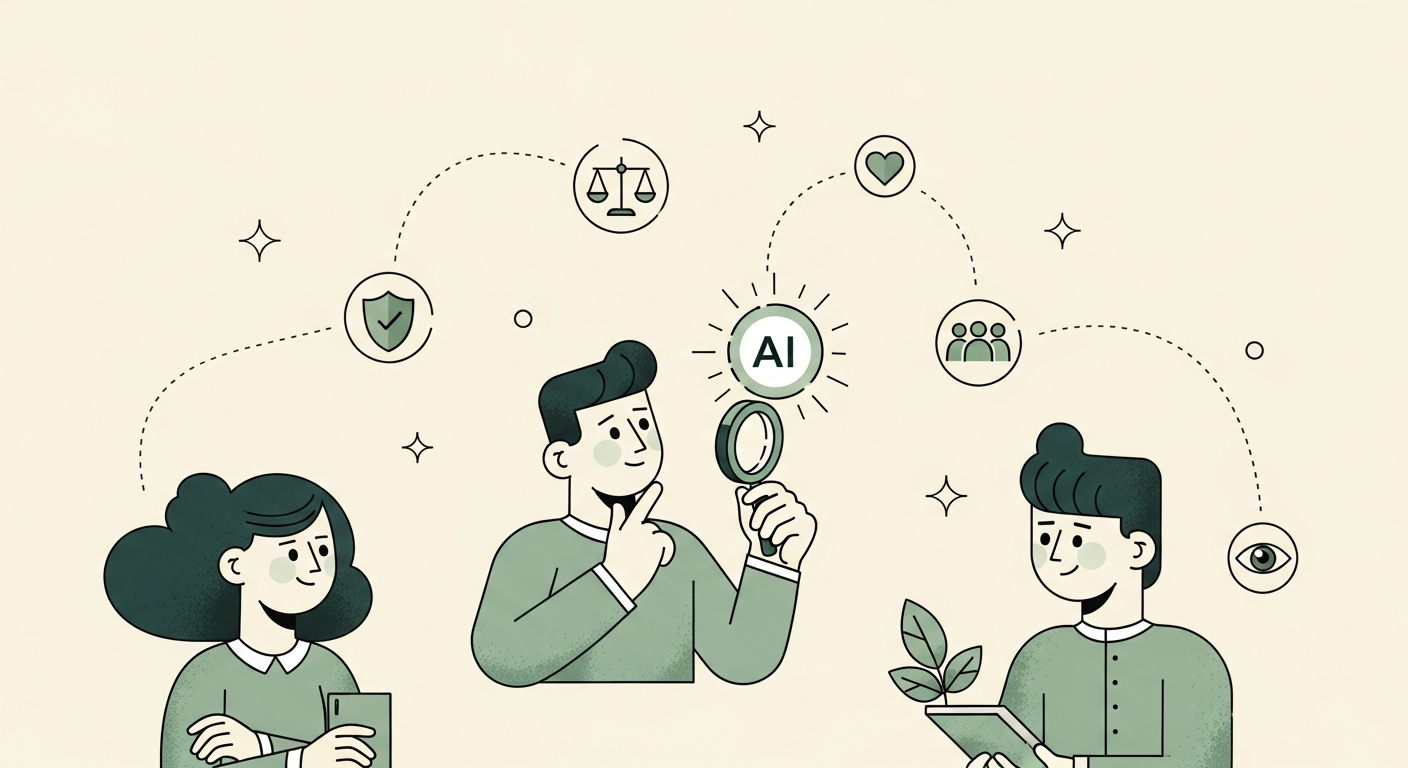
The ethical questions around AI used to live in philosophy departments and policy think tanks. They now live inside boardrooms, product reviews, hiring decisions, customer support workflows, and the systems that determine who gets a loan, who gets an interview, and who gets a medical referral. As AI has moved from research lab to operational reality across nearly every industry, the ethical concerns have stopped being abstract and have started showing up in real incidents, real lawsuits, and real reputational damage to companies that did not take them seriously enough.
This guide walks through the most important ethical concerns in AI development and deployment today, what each one actually looks like in practice, and the responsible approach to addressing them. The goal is not to slow adoption. The goal is to help leaders build AI programs that hold up under scrutiny, because the companies that get this right will be the ones still operating in the same form a decade from now.
Why AI Ethics Is a Leadership Topic Now
Three shifts have moved AI ethics out of the academic conversation and into the operating one.
AI is now embedded in consequential decisions. Hiring, lending, medical triage, insurance underwriting, customer service, and content moderation all increasingly rely on AI. When the decision matters to a person, the ethics of how that decision was made matters too.
Regulation is catching up, unevenly. The EU AI Act is in staged enforcement, sector specific guidance in the United States is expanding, and a growing list of state laws now make many ethical concerns legal obligations in at least some jurisdictions. Companies that built AI programs without an ethical foundation are increasingly being asked to retrofit one under regulatory pressure.
Public scrutiny is real. Customers, employees, journalists, and investors all pay attention to AI behavior, and a single visible failure can cause lasting damage. The cost of doing ethics badly is no longer theoretical.
The Core Ethical Concerns
1. Bias and Fairness
AI systems learn from historical data. When that data reflects historical inequities, the model reproduces and often amplifies them. A hiring model trained on the resumes of a company that historically hired one demographic learns to favor that demographic. A lending model trained on past approval patterns learns to repeat past discrimination. A facial recognition model trained mostly on lighter skinned faces performs worse on darker skinned faces.
Bias is the most studied ethical concern in AI, and one of the most common sources of failure in real deployments. Responsible development requires deliberate evaluation across demographic groups, intentional curation of training data, and ongoing monitoring after deployment because bias can emerge as the world changes around the model.
2. Transparency and Explainability
Many AI systems, especially modern large models, are difficult to interpret. The model produces an answer, but the reasoning is not easily inspectable. When a person is affected by an AI decision, they have a reasonable expectation of understanding why. When a regulator audits the system, the company needs to explain how it works.
The ethical concern is that AI can be used as a way to make decisions without ever having to justify them. The responsible posture is to require explainability proportional to the stakes of the decision, to disclose when AI is being used, and to maintain documentation that a non technical reviewer can follow.
3. Privacy and Data Consent
AI models are built on data, often a lot of it. The ethical questions are layered. Was the training data collected with appropriate consent. Does the model expose sensitive information in its outputs. Does the operational use of the model process personal data in ways the user did not anticipate. Does the company have a clear lawful basis for the data flows that feed the model.
Privacy concerns are not solved by anonymization alone. Modern models can sometimes regurgitate training data, and combined data sources can re identify individuals who were ostensibly anonymous. The responsible approach is purpose limitation, minimization, transparency to the people whose data is involved, and the technical controls to keep sensitive data out of the wrong models.
4. Intellectual Property and Creative Attribution
Many large models were trained on enormous quantities of text, images, code, and other creative work. The legal question of whether that training was permissible is being actively litigated. The ethical question is whether creators whose work shaped the model are being fairly compensated and credited, and whether AI generated outputs that closely mirror existing creative work are acceptable.
This concern affects both companies building models and companies deploying them. Buyers should understand the provenance of the models they use. Deployers should set policies about what AI generated content can be claimed as original work and how source attribution is handled when the output draws heavily on a recognizable style.
5. Misinformation, Deepfakes, and Synthetic Content
Generative AI makes it trivial to create convincing fake images, audio, video, and text. The ethical concerns range from individual harm, like non consensual deepfakes, to societal harm, like coordinated misinformation campaigns. Even routine business use cases create exposure when AI generated content is presented as factual without verification, because the model can confidently state things that are wrong.
Responsible deployment includes provenance signals where possible, clear labeling of synthetic content in customer facing contexts, and human review for any content that will be published as a factual claim. Companies also have a responsibility to think about how their tools might be misused and to design safeguards accordingly.
6. Labor and Economic Displacement
AI is reshaping work. Some tasks are being automated entirely, some are being augmented, and some jobs are being restructured around AI assistance. The ethical concerns are both individual and collective. Individually, workers whose roles change deserve clear communication, retraining support, and fair treatment in the transition. Collectively, the distribution of AI's economic gains is a real question that companies, governments, and communities are still working through.
A responsible employer treats AI driven role changes with the same care given to any major organizational change. Transparent communication, investment in upskilling, and honest conversations about which roles will look different should be treated as core requirements rather than nice to haves. They are part of what it means to deploy AI ethically inside a company.
7. Concentration of Power
A small number of companies control the most capable AI models, the compute required to train them, and the data flywheels that improve them. This concentration raises concerns about market competition, geopolitical leverage, and the ability of any single company to influence what billions of people read, see, and believe through their AI products.
For most organizations the practical response is to maintain optionality. Avoid total dependence on a single model provider, support open source alternatives where appropriate, and stay informed about the broader ecosystem so the company is not caught off guard by a sudden change in a critical supplier.
8. Environmental Impact
Training and running large AI models consumes significant energy and water. The total footprint of the global AI build out is reported by major operators and researchers to be material and growing, even as efficiency per query improves. The ethical concern is both about absolute impact and about whether the energy and resources are being used responsibly, with credible commitments to clean energy and efficient infrastructure.
For deployers, the responsible posture is to ask vendors about their efficiency and energy sourcing, to design workflows that do not call expensive models unnecessarily, and to consider environmental impact alongside cost and performance when choosing tools.
9. Safety and Autonomous Action Risks
As AI moves from passive assistants to autonomous agents that take action in the real world, the safety stakes rise. An agent that can send email, move money, schedule appointments, or operate a robot can also do those things incorrectly at scale. The ethical concerns include both immediate safety, such as preventing harmful actions, and longer term concerns about ensuring that increasingly capable systems remain aligned with human intent.
Responsible deployment of autonomous AI requires clear scope, strong guardrails, monitoring of agent actions, and the ability to intervene quickly when something goes wrong. The blast radius of an autonomous agent should always be matched to the level of testing and oversight in place.
10. Accountability Gaps
When an AI system causes harm, the question of who is responsible can become murky. Is it the company that built the model, the company that deployed it, the team that integrated it into a workflow, or the individual employee who used it. The ethical concern is that AI can create diffusion of accountability, where everyone points at someone else and the affected person is left without recourse.
Responsible programs answer the accountability question in advance. A specific person owns each AI use case. The vendor contracts allocate liability clearly. The customer facing communication makes it clear who is responsible for the outcome. None of this prevents incidents, but it ensures that when an incident happens, the path to making it right is clear.
Concerns Specific to the Development Phase
Beyond the general categories, the development phase has its own ethical considerations.
Training data sourcing. Where the data came from, whether the consent and licensing are clear, and whether any of the data should not have been included at all.
Data labeling labor. Many models depend on human annotators. The conditions, pay, and psychological support for those workers, who often see disturbing content, are a real ethical concern that the industry is still grappling with.
Model evaluation. The choice of evaluation benchmarks shapes what the model is good at. Models evaluated only on average performance may hide poor performance on edge cases or specific groups. Responsible development uses diverse evaluation sets and reports performance breakdowns.
Red teaming and safety testing. The investment in adversarial testing before release determines how many harmful behaviors get caught early. Skipping this stage to ship faster is a real ethical shortcut, not just a technical one.
Documentation and disclosure. Model cards, system cards, and clear disclosure of known limitations let downstream users make informed decisions. The absence of this documentation is itself an ethical issue.
Concerns Specific to the Deployment Phase
Deployment introduces a different set of concerns even when the underlying model is well built.
Use case selection. Some use cases are too high stakes for current model capabilities. Choosing not to deploy AI for a particular decision is sometimes the most ethical choice.
Human oversight design. Putting a human in the loop only counts if the human has the time, training, and authority to actually exercise oversight. Symbolic oversight creates a false sense of safety.
User disclosure. People interacting with AI generally have a right to know they are interacting with AI, especially in contexts where they might assume they are talking to a person.
Ongoing monitoring. Models drift. The world changes. A model that was fair and accurate at deployment can become neither over time without monitoring. Treating deployment as a one time event rather than an ongoing responsibility is a common ethical failure.
Feedback channels. Affected people should have a clear way to flag concerns, contest decisions, and trigger human review. Programs without this channel deny people meaningful agency.
How to Address These Concerns in Practice
Good intentions are not enough. The companies that handle AI ethics well share a few operational practices.
A named owner. Ethics without a single accountable person becomes everyone's responsibility and therefore no one's. The owner has the authority to stop a project that crosses a line.
An ethics review built into the development and deployment process. Not a separate committee that meets quarterly, but an integrated step in the workflow that surfaces concerns when there is still time to address them.
A tiered risk framework. Not every use case needs the same scrutiny. A meeting summarizer for internal notes is different from an algorithm that affects employment decisions. The framework lets the company apply proportionate care without becoming a bottleneck.
Diverse perspectives. Ethics work benefits from people with different backgrounds, disciplines, and experiences. A review process that includes only the engineering team will miss concerns that a more diverse group would surface immediately.
Real measurement. Bias audits, fairness metrics, accuracy across demographic slices, and incident tracking turn ethics from a values statement into an operational discipline.
Vendor scrutiny. Most AI in any given company comes from third party vendors. Asking vendors about their training data, evaluation practices, safety testing, and incident history is part of responsible procurement.
Continuous learning. The ethical landscape changes as the technology changes. A program that reviews its policies annually and updates them based on what has been learned stays current. A program that writes a policy once and files it does not.
Frameworks and Principles to Anchor On
Several established frameworks give organizations a useful starting point.
NIST AI Risk Management Framework organizes responsible AI work around four functions: Govern, Map, Measure, and Manage. It is widely adopted and a strong baseline for most US based companies.
OECD AI Principles emphasize inclusive growth, human centered values, transparency, robustness, and accountability. They are the vocabulary many regulators use.
ISO/IEC 42001 is the international management system standard for AI. Certification against it is starting to appear as a trust signal in enterprise procurement, similar to how ISO 27001 functions for information security, though adoption is still maturing.
The EU AI Act codifies risk tiers and the obligations that apply to each, with different provisions phased in over time rather than all in force at once. Even companies outside the EU often use it as a reference for how to categorize and govern their use cases.
Industry specific guidance from financial regulators, healthcare authorities, employment regulators, and others adds another layer for companies in those sectors.
Why This Matters for Every Leader
It is tempting to treat AI ethics as a topic for someone else. The legal team, the compliance team, the dedicated AI ethicist if the company has one. The reality is that ethical decisions about AI are being made every day by product managers choosing what to ship, by engineers choosing what data to use, by marketers choosing what content to publish, and by support agents choosing whether to rely on an AI generated response. Without leadership attention, those decisions are made under time pressure and without a shared framework.
Leaders who treat AI ethics as a strategic capability rather than a compliance afterthought build companies that move faster, retain trust, and avoid the visible failures that have damaged some of their peers. The ethical posture of a company shows up in its products, its customer relationships, its employee experience, and ultimately its long term performance.
The Bottom Line
The major ethical concerns in AI development and deployment include bias and fairness, transparency and explainability, privacy and consent, intellectual property, misinformation and synthetic content, labor displacement, concentration of power, environmental impact, safety of autonomous systems, and accountability gaps. Each one has both a development phase dimension and a deployment phase dimension, and each can be addressed with deliberate practices rather than left to chance.
The frameworks exist. The playbooks are becoming clearer. The companies that take AI ethics seriously now are best positioned to keep earning trust as the technology and the rules around it continue to evolve. The work is real, and the time to do it is while you still have the chance to set the standard rather than respond to a failure.
If you want help building an AI program that handles these concerns from the start, we are happy to talk through what that looks like in your context.