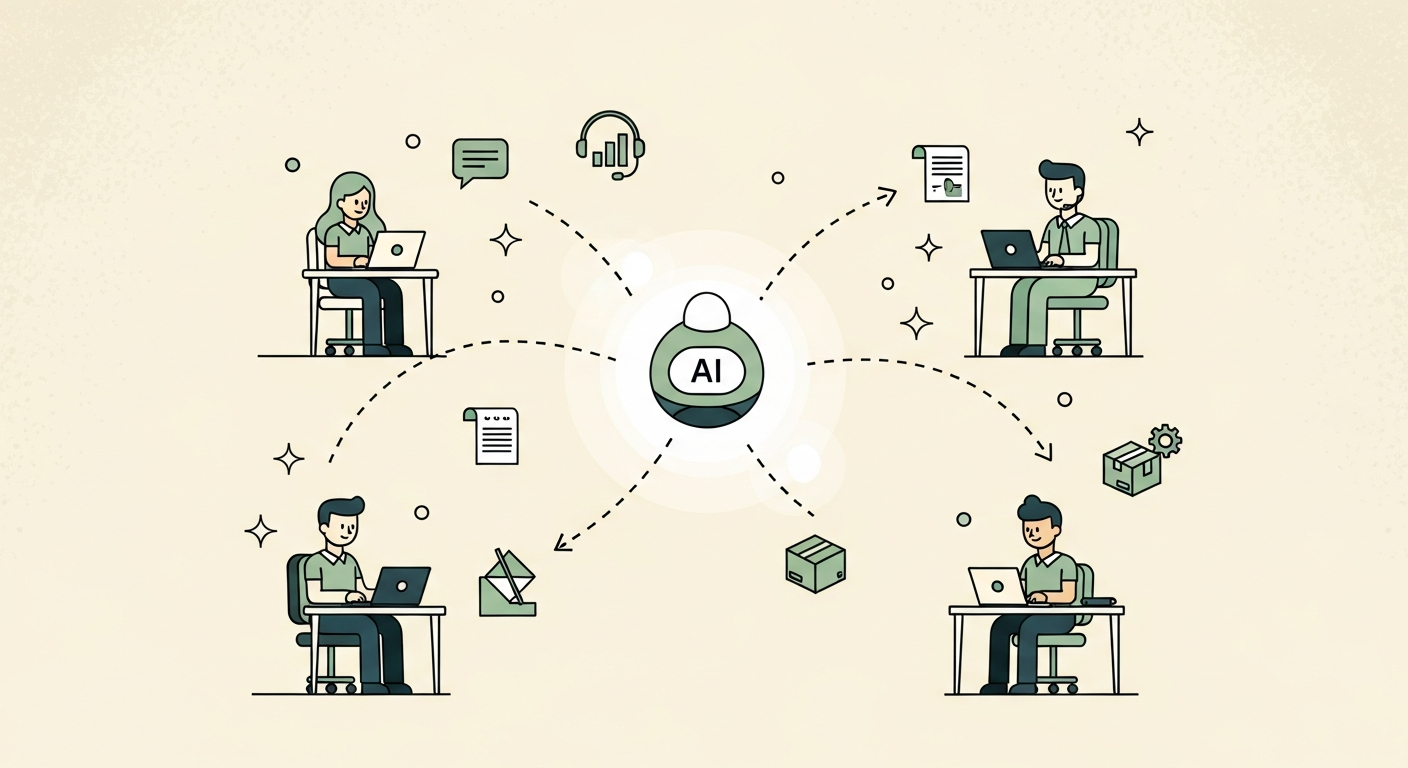
AI in business has stopped being a future tense conversation. Across most major industries, companies are now running real AI inside real workflows and reporting real numbers on what changes. Some of those numbers are impressive. Some are more modest than the headlines suggest. The most useful thing for any business leader trying to figure out where to start is to look at a wide range of concrete examples, understand what they actually did, and then ask which patterns might apply to their own operations.
This guide walks through real examples of AI improving business processes across the most common functions of a typical company. The examples are drawn from publicly reported deployments at named companies and from the broader pattern of how AI is being applied in each area. The goal is not to argue that every example will work everywhere. It is to give a useful tour of where the technology is paying off, what shape the improvements actually take, and what to keep in mind when planning your own work.
Customer Support and Service
Customer support has been one of the earliest and clearest applications of generative AI in business. The shape of the work, where customers ask questions that have answers somewhere in the company's knowledge base, is a strong fit for large language models that can read context and write natural responses.
The most widely cited example is Klarna, the Swedish payments company. In early 2024 Klarna disclosed that an AI assistant built on OpenAI technology was handling roughly two thirds of its customer service chats within its first month of full deployment, performing work equivalent to about 700 full time agents and resolving conversations significantly faster than the human baseline while maintaining customer satisfaction scores at parity. The company estimated a profit impact of about 40 million dollars in the first year. The deployment also generated some pushback over the following year, with Klarna later saying it had pulled back somewhat and reinvested in human agents for higher complexity cases, which is a useful reminder that AI deployments often settle into a mixed model rather than a pure replacement.
Beyond Klarna, the pattern across consumer companies has been similar. Airline reservation flows, retail order issues, telecom account questions, and software product support are all areas where AI assistants now handle a substantial share of routine cases, with human agents handling escalations and complex situations. The financial outcomes typically include lower cost per case, faster resolution times, and higher consistency of answers. The most common failure mode is over deployment, where AI is asked to handle situations that really need a person, and customer satisfaction suffers as a result.
Sales and Revenue Operations
Sales is another area where AI is showing up in many small ways that add up. Tools like Gong and Chorus have for years been using machine learning to analyze sales calls, surface what high performing reps do differently, and feed insights back into coaching and forecasting. The newer wave of generative AI has added capabilities like automatic call summaries, drafted follow up emails, and meeting preparation briefs assembled from CRM data and prior conversations.
HubSpot, Salesforce, and Microsoft have all built AI assistants directly into their CRM products. The assistants handle tasks like drafting outreach emails personalized to a specific account, summarizing the history with a prospect before a meeting, suggesting next best actions based on similar deals, and writing first drafts of proposals. Sales teams that have adopted these tools tend to report time savings on administrative work, which can translate either into more selling time or into faster cycle times depending on how the team is organized.
On the lead qualification side, AI scoring models have been used for years to predict which leads are most likely to convert and to route them to the right reps. The new generation of these systems combines structured data with text from emails, calls, and meeting notes to produce a richer view of each opportunity than the old rules based scoring systems could provide.
Marketing and Content Operations
Marketing has been one of the most enthusiastic adopters of generative AI, both because the work involves a lot of writing and because the cost of trying things is relatively low. The typical pattern in marketing organizations is that AI is now used to draft first versions of a wide range of content, including blog posts, social posts, ad copy, product descriptions, and emails, with humans editing and approving before publication.
The financial impact in marketing tends to show up as more output for the same headcount rather than as a smaller team. Companies report being able to produce more variations of campaigns, more personalized versions of emails, and more frequent updates to product pages and category descriptions than would have been practical without AI assistance.
On the analytics side, AI is being used to summarize campaign performance, to identify which creative elements are working, and to suggest optimizations. Platforms like Google and Meta have integrated AI tools that automatically generate ad creative variations and adjust bidding in real time, which is a continuation of work those platforms have done for years using earlier generations of machine learning.
One notable consumer example is Duolingo, which has integrated generative AI deeply into its product. The company uses AI to generate practice content, to power conversational language partners for paid subscribers, and to draft material that human language experts then review and refine. Duolingo has been public about both the gains and the trade offs of this shift, including reductions in some contractor categories and a reorganization of the human roles around AI assisted production.
Software Engineering
Software engineering is the function where AI productivity gains have been most rigorously studied. GitHub Copilot, which uses large language models to suggest code as developers type, has been adopted by millions of professional developers since its launch. Studies by GitHub and by independent researchers have generally found that developers using Copilot complete certain coding tasks materially faster than developers without it, with reported gains varying by task type and experience level. A widely cited GitHub study reported developers writing code about 55 percent faster on a controlled task with Copilot, with the usual caveat that controlled task results do not necessarily translate one for one to messy real world projects.
Beyond Copilot, the broader AI coding ecosystem has expanded rapidly. Tools like Cursor, Cognition's Devin, and Replit's AI agents go further, handling larger units of work like generating entire functions, debugging across multiple files, and writing tests automatically. Adoption of these newer agentic tools is still early but growing quickly, and the companies running serious pilots report improvements in developer productivity, faster onboarding for new hires, and better consistency on routine work like writing tests and translating between programming languages.
The work is not all upside. Code generated by AI still needs careful review, can introduce subtle bugs, and sometimes encourages developers to accept suggestions they do not fully understand. The companies seeing the strongest results have generally paired the tools with clear engineering practices around review, testing, and ownership.
Finance and Accounting
Finance and accounting have a long history with automation, going back to rules based robotic process automation systems for tasks like invoice processing and reconciliation. AI has extended those capabilities significantly.
JPMorgan Chase has been one of the most visible examples in financial services. The bank's COiN platform, first reported publicly in 2017, uses machine learning to review commercial loan agreements in a fraction of the time that human lawyers and loan officers previously needed for the same work. The bank has continued to invest heavily in AI across the firm, including a generative AI assistant called LLM Suite rolled out to tens of thousands of employees in 2024 and other internal tools for research analysts and operations teams.
In the broader market, accounts payable automation platforms like Bill.com, Tipalti, and AvidXchange use AI to extract data from invoices, match them to purchase orders, route them for approval, and post them to accounting systems with minimal human handling. Expense management platforms like Ramp and Brex use AI to categorize transactions, flag anomalies, and enforce policy without requiring employees to manually code expenses.
On the reporting and analysis side, finance teams are using AI to draft commentary for management reports, to summarize variance analyses, and to answer ad hoc questions about financial data through natural language interfaces. These applications tend to produce material time savings for finance teams that previously spent a lot of effort on the formatting and explanation layer of reporting work.
Human Resources and Recruiting
HR is a function where AI has been used carefully because of the regulatory and reputational stakes of getting it wrong. The work that has tended to produce the cleanest wins is in administrative and content tasks rather than in high stakes decisions about specific people.
On the recruiting side, AI is widely used to write job descriptions, to draft sourcing messages, to schedule interviews, and to summarize candidate profiles. Tools like LinkedIn's AI assisted recruiter features and Eightfold's talent intelligence platform help recruiting teams handle higher volume with the same staffing.
On the employee experience side, AI assistants are now common for handling routine HR questions like benefits enrollment, leave policies, and onboarding logistics. ServiceNow, Workday, and other HR platforms have integrated AI assistants that answer common questions and route harder cases to HR business partners.
For learning and development, AI is being used to generate personalized training content, to create role specific onboarding materials, and to provide on demand coaching for managers. These applications tend to expand what is feasible for L&D teams to deliver rather than to replace what they were already doing.
For the more sensitive uses of AI in HR, including resume screening and performance evaluation, organizations have been more cautious. Regulatory developments like New York City's automated employment decision tool law and the EU AI Act have made companies more careful about where AI sits in decisions that affect individual employees, and the strongest current practice is to use AI to support human judgment rather than to replace it for these categories of decisions.
Supply Chain and Operations
Supply chain is one of the oldest applications of advanced analytics in business, and AI has continued to extend what is possible. Walmart and Amazon have for many years used machine learning for demand forecasting, inventory placement, and route optimization at scales that would be impossible to manage manually. The newer generation of AI tools has added capabilities like real time disruption response, where the system can detect a supply issue and suggest alternative sourcing or shipping plans within minutes rather than hours or days.
UPS has publicly discussed its ORION route optimization system, originally developed before the generative AI era, which uses advanced algorithms to plan driver routes and has been reported to save the company hundreds of millions of dollars annually in fuel and time. AI is now being layered on top of systems like ORION to handle the increasing complexity of urban delivery and to coordinate with other parts of the network.
In manufacturing, AI is used for predictive maintenance, where sensor data from equipment is analyzed to predict failures before they happen, and for quality inspection, where computer vision systems examine products on the line at speeds and consistency that human inspectors cannot match. Companies like Siemens, GE, and many smaller specialists offer industrial AI platforms that have been deployed across factories worldwide.
Knowledge Work and Internal Productivity
Beyond the function specific examples, one of the biggest categories of AI value in business is general purpose knowledge work assistance. Microsoft 365 Copilot, Google Workspace's Gemini features, and Notion AI sit on top of productivity suites with very large installed bases and are being adopted across many enterprises for tasks like drafting documents, summarizing long emails and meeting transcripts, generating slides, analyzing spreadsheets, and pulling information from across a company's documents. Public reporting on paid seat counts varies, and active use within any given organization depends on rollout and training as much as on raw licensing.
The productivity research on these tools is still maturing. Early studies have generally shown meaningful time savings on a per task basis, with the size of the gains varying widely by task and by user. The most successful deployments have generally been paired with training on how to use the tools well and with adjustments to processes to take advantage of the new capability rather than just bolting AI on top of unchanged workflows.
One pattern that has emerged is that the value of these tools shows up most clearly for repetitive knowledge work that previously could not be automated because it required language understanding. Drafting status updates, summarizing meetings, writing first drafts of memos, and pulling key points out of long documents are all examples where the marginal time savings per task can add up to real hours per week per user.
Healthcare Administration
Healthcare is a domain where AI has been used cautiously in clinical decisions and more freely in administrative and documentation work. The single most widely deployed application has been AI scribes, which listen to clinical encounters and produce draft notes for clinician review.
Companies like Abridge, Nuance with its DAX Copilot, and Suki offer ambient documentation tools that have been adopted by major health systems. Reported benefits include hours of time savings per clinician per week, improved completeness and quality of documentation, and reductions in the after hours work that has been a major driver of clinician burnout. Several large health systems have publicly committed to deploying AI scribes across thousands of clinicians, which is a significant scale for healthcare adoption.
Beyond scribes, AI is being used in revenue cycle management, in prior authorization workflows, in patient communication and triage, and in scheduling and operations. As with HR, the more sensitive applications that affect care decisions for individual patients are being approached more carefully, with the strongest applications today centered on supporting clinical judgment and reducing the administrative load that surrounds it.
Legal and Compliance
Legal work has historically been document heavy and expensive, which makes it a natural target for AI assistance. The category has matured rapidly. Tools like Harvey, built on top of OpenAI models, have been adopted by major law firms for tasks like contract review, legal research, and drafting. Established legal research providers like Thomson Reuters and LexisNexis have integrated generative AI into their research products.
For in house legal and compliance teams, AI is being used for routine contract review, for monitoring regulatory changes, for translating legal language into business friendly summaries, and for assisting with policy drafting. The financial impact tends to show up as faster turnaround on routine work and as the ability to handle higher volume without growing the team proportionally.
As in healthcare and HR, the strongest current practice is to position AI as support for trained professionals rather than as a substitute for their judgment, both for ethical reasons and because professional liability rules in most jurisdictions still rest with the human practitioner.
What the Examples Have in Common
Pulling all of these examples together, a few patterns stand out.
The strongest AI deployments tend to share a few features. They target processes where the work is mostly language based or data based. They use AI to handle the routine portion of the work while leaving the judgment portion to humans. They are paired with changes in process, training, and measurement rather than dropped into unchanged workflows. They have clear quality controls so that AI mistakes are caught and addressed.
The most common failure modes are also consistent. Deployments that try to replace humans entirely in customer facing or high stakes work tend to backfire. Deployments that lack clear quality control produce mistakes that erode trust faster than the cost savings can rebuild it. Deployments that lack training and process change produce smaller gains than the technology should have delivered.
The financial impact varies widely. Some deployments produce dramatic numbers like the Klarna result. Many produce more modest but real gains in the range of 10 to 30 percent time savings on the targeted tasks. A few produce no measurable improvement, usually because the deployment did not address the binding constraint in the process.
How to Think About Where to Start
If you are leading a function or running a business and trying to figure out where AI will pay off in your own operations, the examples above suggest a useful set of starting questions.
Which processes consume a lot of time and produce outputs that are mostly language or mostly structured data? Those are the highest probability candidates for AI assistance today.
Which processes have a clear quality bar that AI output can be checked against? AI is much easier to deploy where you can tell quickly whether the output is good than where the quality only becomes apparent much later.
Which processes have enough volume to justify the work of getting AI right? Small pilots can prove the concept, but the financial impact tends to come from processes with enough scale that even modest per case improvements add up.
Which processes are at low enough stakes that early mistakes are recoverable? Starting in low stakes areas builds organizational skill before tackling areas where mistakes would be expensive or harmful.
Which processes can be paired with training, process change, and quality control? AI tends to underperform when it is bolted onto unchanged work and overperform when it is part of a redesigned process.
The Bottom Line
AI is improving real business processes today across nearly every major function. Customer support deployments at scale are saving large amounts of money and shifting how teams are structured. Sales and marketing tools are producing more output and freeing time for higher value work. Software engineering tools are speeding up well defined tasks for trained developers. Finance, HR, supply chain, healthcare administration, and legal work are all seeing concrete gains in specific applications.
The most useful way to read the examples is not as a prediction of what will work in your business but as a map of where the technology is paying off and what shape the deployments tend to take. The companies seeing the strongest results are not the ones with the most advanced technology. They are the ones doing the careful work of picking the right processes, redesigning them to take advantage of AI capability, training their people, and measuring the actual impact rather than the assumed impact.
That work is open to any company willing to do it. The technology is widely available, the playbooks are reasonably well understood, and the early adopters have done a lot of the experimentation in public. What separates the businesses that get real value from AI from the ones that mostly get a lot of demos and pilots is the discipline to treat AI deployment as serious process work rather than as a magic upgrade. The good news is that the businesses doing it well are also showing what the discipline actually looks like, which makes it easier than ever for the next wave to follow.