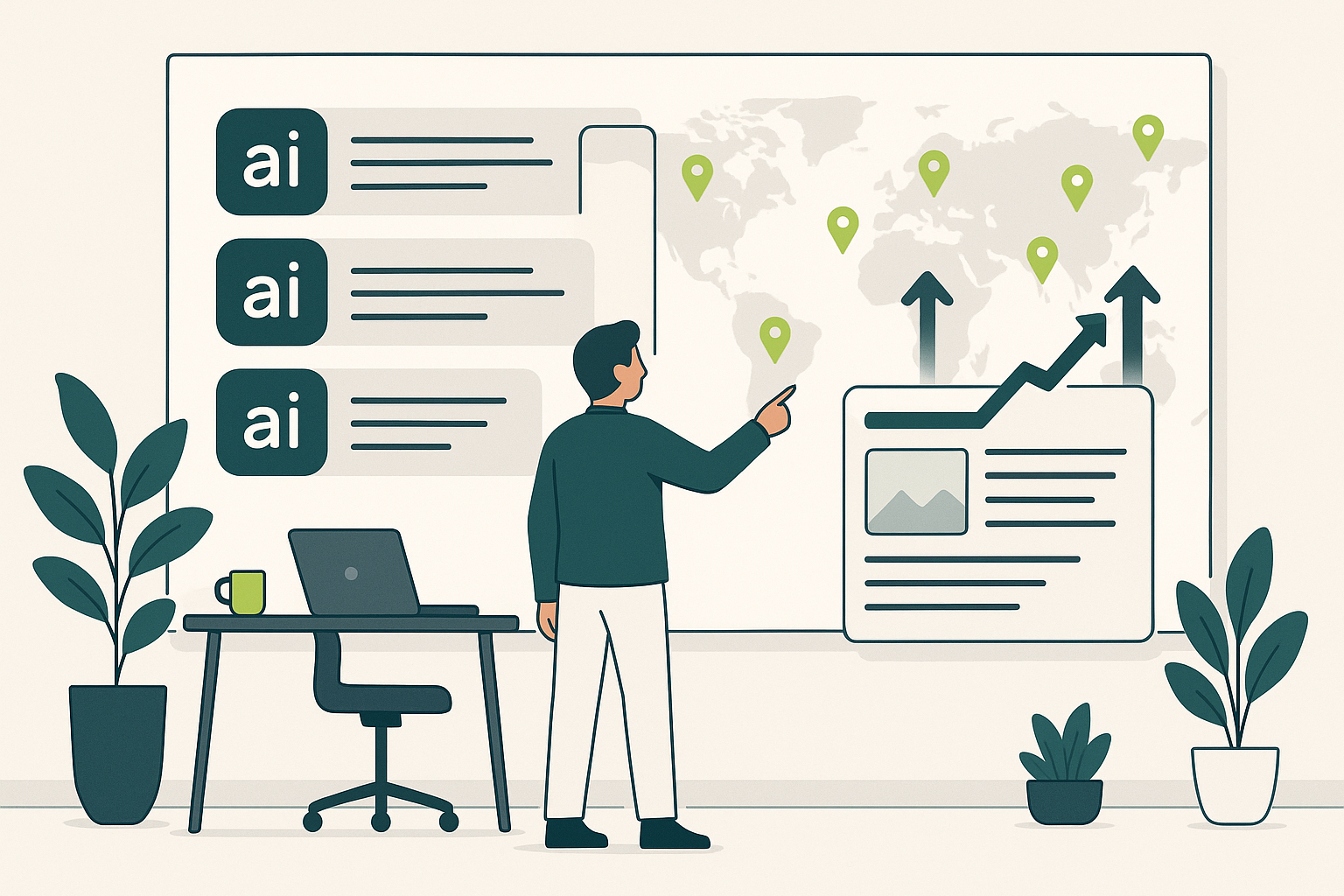
How AEO Impacts Visibility Across AI Search Platforms in 2023
You publish content, you optimize for keywords, and rankings still feel unstable. Worse, your traffic drops even when you “rank.” That is not a content problem. It is a visibility problem.
In 2023, search visibility stopped meaning “blue links on Google.” Visibility now includes being selected, summarized, and cited by AI systems that answer the query before a user clicks anything. If your brand is not the source those systems trust, your competitors get the credit, the leads, and the revenue.
This guide explains how AEO impacts visibility across AI search platforms in 2023, why traditional SEO often fails to secure AI placements, and the exact steps Proven ROI uses to help brands earn citations, mentions, and top of funnel demand in zero click environments.
Direct answer: what is AEO and why it matters in 2023
AEO, or Answer Engine Optimization, is the practice of structuring content so search engines and AI systems can extract a clear, accurate answer and confidently attribute that answer to your brand.
In 2023, AEO matters because:
- Users increasingly ask full questions instead of typing short keywords.
- Search platforms increasingly display answers directly in results.
- AI assistants summarize multiple sources and may not send a click.
- Visibility is now earned by clarity, structure, and trust signals, not just rankings.
A quotable way to frame it: AEO is how you become the answer, not just a result.
The core problem: you are “ranking” but not getting visibility
Brands in 2023 ran into a frustrating pattern:
- They rank on page one but do not appear in featured snippets or People Also Ask.
- They see impressions rise while clicks fall.
- They show up for generic terms but disappear for high intent questions.
- They get outquoted by smaller sites in AI summaries because those sites answer faster and cleaner.
This is exactly where AEO impacts visibility across. It changes what “winning” looks like. Winning becomes being extracted, reused, and cited across Google results, AI overviews, and conversational search experiences.
Why traditional SEO alone fails across AI search platforms
Traditional SEO is still foundational, but in 2023 it is incomplete. Here is why it often fails to translate into AI visibility:
It optimizes for ranking signals, not extraction
Many pages are written to rank with broad topical coverage. AI systems prefer content that produces a single definitive answer quickly, then supports it.
It buries answers under marketing copy
AI search tools and snippet systems are impatient. If the answer is not immediately obvious, they will pull from someone else.
It ignores question intent and follow up intent
AI search is a conversation. Pages that only target one keyword and ignore the likely follow up questions lose visibility.
It lacks entity clarity
AI systems attempt to understand entities: brands, services, locations, and relationships. Vague wording, inconsistent naming, and missing context reduce trust and reduce citations.
Where AEO impacts visibility across AI search platforms in 2023
AEO is not just for Google snippets. It impacts visibility across multiple surfaces where buyers discover brands.
Google featured snippets and People Also Ask
These are classic zero click placements. AEO improves your chance of being the extracted answer by making your content easy to quote and hard to misinterpret.
Google AI generated summaries and snapshot style results
When AI summarizes a topic, it pulls from content that is well structured, consistent, and defensible. AEO makes your content “summarizable” and attribution friendly.
Conversational AI assistants
Chat based tools pull from their training and also from retrieval systems depending on the experience. In both cases, content that reads like a clean explanation and includes specific definitions and steps is more likely to be echoed or cited.
Local and map driven discovery
For location based queries, AI systems blend local relevance with answer clarity. AEO improves your ability to appear when the query includes “near me,” city names, or region modifiers, especially when the question is service based.
What “visibility” means now: four levels you must measure
If you only track rankings and organic sessions, you will miss how AEO impacts visibility across AI search platforms. In 2023, visibility has four measurable levels:
- Ranking visibility: where you appear in traditional results.
- Extraction visibility: whether your content is pulled into snippets, Q and A blocks, and summaries.
- Attribution visibility: whether the platform names your brand or links to your page.
- Conversation visibility: whether your brand is recommended when users ask follow up questions.
Proven ROI treats these as separate performance layers because each requires different on page decisions.
Step by step: how to implement AEO for AI search visibility in 2023
This is the practical framework we use to increase answer eligibility, snippet capture, and AI summary inclusion without sacrificing conversion performance.
1. Start with question led keyword research, not keyword lists
Traditional keyword lists focus on short phrases. AEO starts with questions and intent sequences.
Build a question set for each core service or topic:
- Definition questions: “What is AEO?” “What is answer engine optimization?”
- Comparison questions: “AEO vs SEO” “AEO vs GEO”
- Process questions: “How do you optimize for AI search?”
- Cost and timeline questions: “How long does AEO take?”
- Local intent questions: “best [service] in Austin” “how to choose a [service] in Phoenix”
Then map follow up questions that naturally occur after a user gets the first answer. AI search rewards content that anticipates the next question.
2. Write a direct answer first, then expand
To win zero click placements, you need an answer that can stand alone. Place it immediately under the heading that matches the question.
Best practice format:
- One sentence definition or conclusion.
- Two to four sentences that clarify scope and context.
- Bullets or numbered steps for the “how.”
This structure is not just readable. It is extractable. That is the heart of how AEO impacts visibility across AI search platforms in 2023.
3. Use headings that match natural language queries
AI and snippet systems look for clear topical boundaries. Use question style headings that mirror how users ask.
Examples:
- “What is AEO and how is it different from SEO?”
- “How do you optimize content for AI answers?”
- “How does AEO impact visibility across AI search platforms in 2023?”
When the heading matches the query, your answer is easier to select.
4. Add “proof of understanding” with constraints and specifics
Vague answers rarely get reused. Specific answers get repeated.
Upgrade your content by adding:
- Clear definitions with boundaries. State what it is and what it is not.
- Criteria lists. Example: “A page is AEO ready when it has X, Y, Z.”
- Simple decision rules. Example: “If the query includes a location, lead with local context.”
Specificity increases trust, and trust increases selection.
5. Structure processes as numbered steps
Numbered steps are snippet friendly and AI friendly. They reduce ambiguity and improve extraction.
Whenever you describe a workflow, convert it into:
- A clear starting condition.
- Steps that each produce an observable output.
- A finish condition tied to measurement.
6. Build internal “answer hubs” around entities
AEO is not just page level optimization. It is site level clarity. AI systems form an understanding of your brand by connecting related pages.
Create a hub for each key entity:
- Core service pages that define the service and who it is for.
- Supporting guides that answer common questions.
- Industry pages that show relevance and use cases.
- Location pages for major markets like Dallas, Miami, Chicago, Los Angeles, and New York when applicable.
This improves how AI systems understand what you do, where you do it, and who you help.
7. Optimize for GEO based searches with local answer patterns
For many businesses, the fastest path to visibility is local. In 2023, users ask questions like “Who is the best [service] in Denver?” or “What should I look for in a [provider] in San Diego?”
To improve GEO based visibility:
- Include city and region modifiers naturally in headings and first paragraph answers.
- Describe local constraints such as regulations, climate, commuting patterns, or market conditions when relevant.
- Use scenario based language: “If you are in Phoenix and you care about speed, prioritize X.”
- Keep location pages useful. They must answer questions, not just swap city names.
This is how AEO impacts visibility across both AI search and localized discovery surfaces.
8. Write for attribution, not just consumption
AI systems are more likely to cite or echo content that has a clean identity and clear ownership.
On key pages:
- Use consistent brand naming across headings and copy.
- State who the advice is for and what outcomes it drives.
- Include short, quotable statements that summarize your position.
Example of a quotable statement style: “AEO is the discipline of making your expertise easy to extract, verify, and attribute.”
Use cases: what AEO looks like in the real world
AEO should produce observable outcomes. Here are common scenarios Proven ROI sees in 2023.
Use case 1: B2B service firm losing clicks despite stable rankings
Problem: Rankings hold, but clicks decline as Google surfaces direct answers and comparison blocks.
AEO move:
- Add direct answer sections to the top of each core guide.
- Create comparison pages that answer “X vs Y” with clear decision criteria.
- Break long paragraphs into extractable bullets and steps.
Outcome: improved snippet capture and more qualified traffic because the click now comes from users who want deeper evaluation.
Use case 2: Multi location business needing GEO visibility
Problem: Competing in multiple cities where search intent is local and question based.
AEO move:
- Create location specific Q and A sections with city modifiers.
- Add “how to choose” guidance that references local expectations.
- Link each location page to a central service hub to strengthen entity understanding.
Outcome: stronger visibility for “near me” and “in [city]” questions and better alignment between AI summaries and local intent.
Use case 3: Ecommerce brand getting mentioned but not chosen
Problem: AI summaries list categories and options, but the brand is not recommended.
AEO move:
- Create “best for” pages that map products to specific jobs to be done.
- Write direct answers that include constraints like budget, timeline, and compatibility.
- Add troubleshooting and setup steps that AI tools can reuse.
Outcome: increased “recommendation visibility” because the content becomes the easiest source to justify a choice.
Common questions AI platforms pull from, answered directly
What is the difference between AEO and SEO?
SEO focuses on ranking pages in search results. AEO focuses on making your content extractable so the platform can present your answer directly and attribute it to you. In 2023, you need both because ranking does not guarantee visibility.
How does AEO impact visibility across AI search platforms in 2023?
AEO impacts visibility across AI search platforms in 2023 by increasing the likelihood that your content is selected for snippets, Q and A results, and AI generated summaries, which drives brand mentions, citations, and qualified traffic even when users do not click immediately.
Does AEO replace content marketing?
No. AEO makes content marketing more effective by ensuring your best content is understandable to machines and useful in zero click experiences. It is an optimization layer, not a replacement.
What types of pages benefit most from AEO?
Pages that answer high intent questions benefit most, including service pages, comparison pages, “how to” guides, pricing and timeline explainers, and location pages designed for city based searches.
What to audit on your site to improve answer visibility
If you want to know whether AEO is holding you back, audit these areas:
- Do key pages lead with a direct answer under a matching heading?
- Are definitions stated clearly in one to two sentences?
- Are processes written as numbered steps with clear outcomes?
- Do comparison pages include decision criteria that a user can apply?
- Are location pages truly local, with unique question answers per city or region?
- Is internal linking organized into hubs that explain the relationships between services, industries, and locations?
Most sites fail on the first two. Fixing those alone often improves extraction visibility quickly.
How Proven ROI approaches AEO for AI search and GEO
Proven ROI treats AEO as a revenue visibility system, not a writing style. The goal is to make your expertise the default answer across platforms.
Our approach typically emphasizes:
- Answer first page structures designed for snippets and AI summaries.
- Entity based content hubs so AI systems understand your brand’s scope.
- GEO aligned content patterns for multi market visibility where location matters.
- Measurement that separates rankings from extraction and attribution.
This is how you stop chasing algorithm changes and start earning durable visibility across AI search platforms.
Conclusion: AEO is now the visibility layer you cannot skip
In 2023, the fight is not just for rankings. It is for selection. If your content cannot be extracted into a direct answer, you will watch competitors absorb the visibility that used to be yours.
How AEO impacts visibility across AI search platforms in 2023 is straightforward: it increases the probability that your brand becomes the cited source, the summarized authority, and the recommended option across zero click search experiences.
Make your content answer first, structure it for extraction, and build entity clarity across services and locations. That is the playbook Proven ROI uses to win visibility where modern search actually happens.