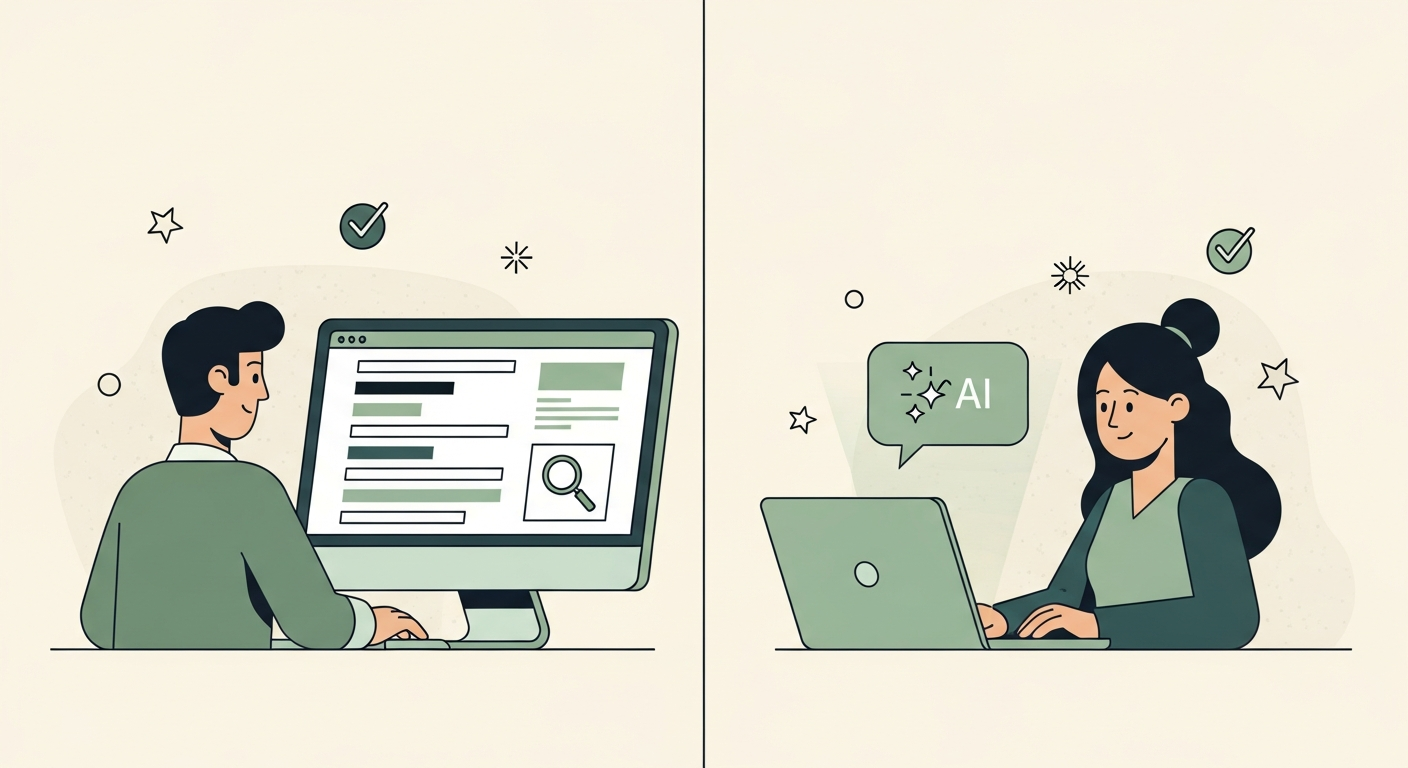
Every quarter someone publishes another article declaring SEO dead. The headlines have been the same for fifteen years. Voice search killed SEO. Mobile killed SEO. Featured snippets killed SEO. Now it is AI's turn.
None of those predictions came true. SEO is not dead. People still search Google over five billion times a day. Organic search still drives more qualified traffic than any other channel for most B2B and local service companies. The mechanics have shifted, the surface has multiplied, but the underlying discipline is alive and well.
Here is the part nobody is saying out loud. SEO is fine. Your absence from AI answer engines is the actual emergency. While SEO professionals argue about whether classic rankings still matter, an entirely new search surface has appeared and most companies have done nothing to show up on it. That is the existential risk, not the death of Google.
What Actually Changed
For two decades, search was a single pipeline. A user typed a query, Google returned ten links, the user clicked one, and you measured the result. SEO was the discipline of being one of those ten links.
That pipeline still exists. It is just no longer the only one. A user with a question now has at least six different surfaces where the answer might appear. Classic Google results, Google's AI Overviews, ChatGPT, Claude, Gemini, Perplexity, plus voice assistants and the growing number of AI features embedded in tools like Notion, Microsoft Copilot, and Slack. Every one of these surfaces builds its answer differently, weights sources differently, and rewards different content patterns.
If you optimized only for classic Google results, you used to capture roughly a hundred percent of the question. Today you capture maybe forty percent, and the share that goes to the other surfaces is climbing every quarter.
The Numbers Tell the Real Story
ChatGPT alone now serves over four hundred million weekly users. Perplexity is processing over a billion queries a year. Google's own AI Overviews appear on the majority of informational queries in many categories, and when they do, classic click through rates drop sharply because the user gets the answer without clicking anything.
None of this means classic SEO is irrelevant. It means classic SEO is necessary but no longer sufficient. The companies still winning are the ones that show up across all surfaces. The companies losing market share are the ones that still treat Google rank as the only metric that matters.
What "Being Ignored by AI" Actually Looks Like
Imagine you sell HVAC services in a major metro. A homeowner asks ChatGPT, "who are the most trusted HVAC companies in my city." The assistant returns a short list of three or four named companies. If your name is not on that list, the homeowner now has a working belief that those three or four companies are the entire serious market.
They will not search Google. They will not see your beautiful ranking on page one. They will not see your ads. They will go to the websites of the named companies, get a quote, and pick one. You have been removed from the consideration set without ever knowing the conversation happened.
Multiply this across thousands of buying decisions every week in your category. The pipeline does not shrink dramatically all at once. It dries up gradually as more of your prospective buyers default to AI shortlists. By the time you notice, the gap between you and the AI preferred competitors is too large to close quickly.
Why Classic SEO Skills Do Not Automatically Transfer
SEO and AI visibility (often called Answer Engine Optimization, or AEO) share roots. Both reward clean structure, authoritative content, fast pages, and trusted backlinks. But the optimization function is meaningfully different.
Classic SEO optimizes for ranking on a page of results. The user is going to scan and click. Your job is to be the most clickable result.
AI visibility optimizes for being cited inside a generated answer. The user will read the answer, not your page. Your job is to be the source the model trusts enough to cite, and to be the brand the model mentions even when it does not link out.
These different goals demand different tactics. AI visibility rewards extractable factual claims, direct answers, explicit numeric specifics, and dense schema markup. It also rewards third party corroboration far more heavily than classic SEO does, because models look for facts that appear across many independent sources before treating them as canonical.
The Companies Quietly Winning
Look at any category where AI assistants regularly provide recommendations and you will see a small number of companies showing up across multiple assistants for multiple variations of the same query. These companies are not necessarily the largest. They are not necessarily the best at classic SEO. They are the ones that started taking AI visibility seriously twelve to eighteen months ago.
What they have in common is consistent. They invested in earning citations on platforms the models trust. They rewrote their key pages to read like clear, extractable answers rather than marketing brochures. They shipped comprehensive structured data. They publish original research that gets quoted in other articles. And they show up in the public conversations that the models read when learning who is who in a given space.
None of this work is exotic. It is the same discipline that classical SEO has rewarded for years, applied to a new set of surfaces with a new optimization function. The companies winning are the ones that recognized AI visibility is a category in its own right, not a sub task of SEO that the same agency can handle in their spare time.
Five Practical Steps to Catch Up Fast
Run a real visibility audit. Pick twenty buying intent queries in your category. Run each in ChatGPT, Gemini, Perplexity, and Google's AI Overviews. Record which brands appear and which do not. This is your baseline.
Identify the citation gap. For every brand outranking you in AI answers, find the third party sources the model is pulling from. Industry directories, review platforms, comparison articles, podcast transcripts, Reddit threads. The gap between your citations and theirs is your work list.
Rewrite your top ten pages. Lead each page with a clear factual claim. Use headings that mirror real buyer questions. Add a frequently asked questions block. Strip vague marketing language and replace it with concrete specifics buyers actually want to know.
Ship comprehensive schema. Organization, Service, Location, Review, FAQ, Article. Validate everything. Fix errors. Most sites have schema gaps that take a single sprint to close and pay dividends for years.
Publish something original every month. Original data, original frameworks, original analysis. Generic content is invisible. Quotable content gets cited, and citations are the currency of AI visibility.
SEO and AI Visibility Are One Practice Now
The smart move is to stop arguing about whether SEO is dead and start treating SEO and AI visibility as one unified practice. Same content team. Same technical foundation. Same measurement discipline, expanded to track AI surfaces alongside classic results.
The companies that integrate the two functions will compound advantage. They will earn classic rankings and AI citations from the same investments. They will measure outcomes across every surface where a buyer can encounter their brand. They will not be surprised when pipeline shifts because they will see the shift forming in their visibility data months before it shows up in revenue.
The companies that keep treating SEO and AI visibility as separate problems, or that ignore AI visibility entirely on the assumption that classic SEO is enough, will spend the next two years quietly losing ground they will never recover.
SEO is not dead. Being absent from the answer is the real death. The fix is straightforward, and the time to start is now.