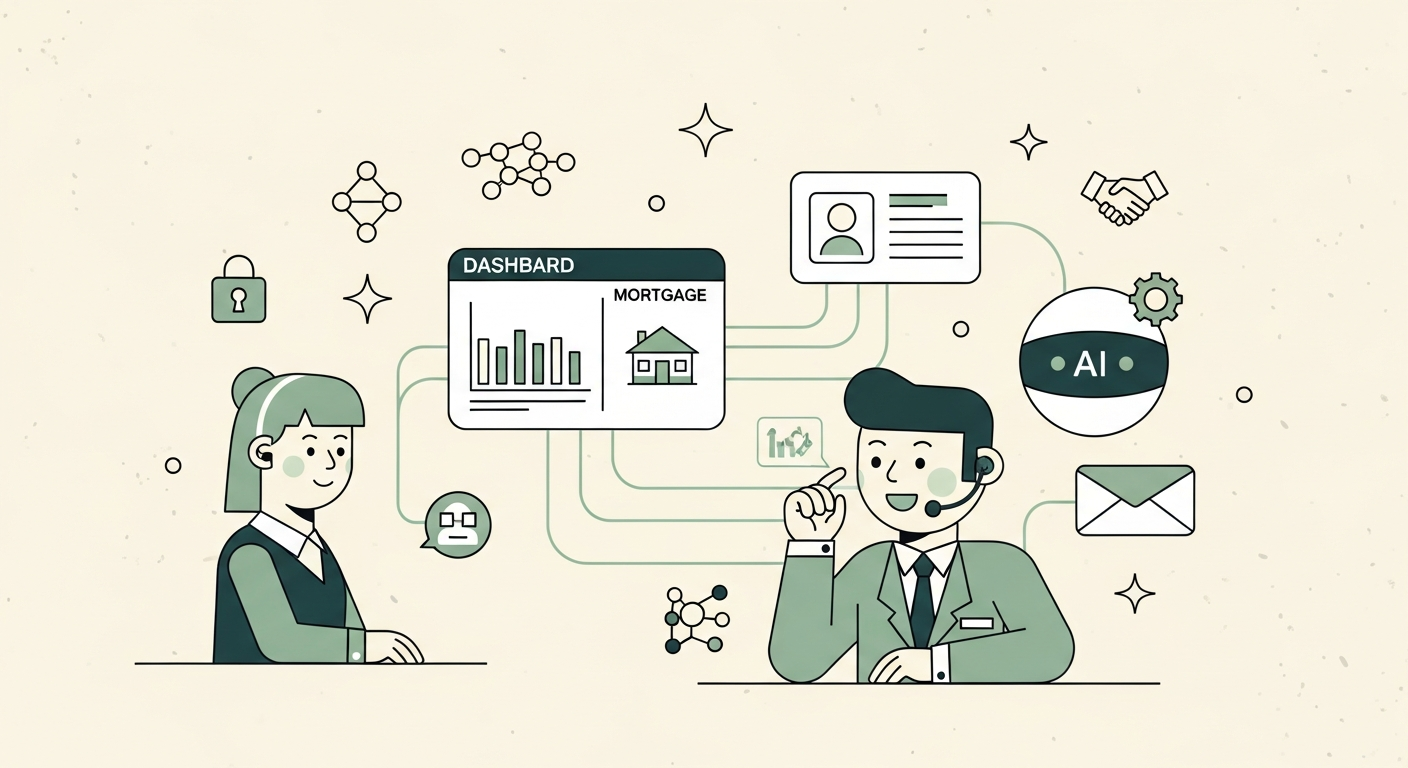
If you lead marketing, technology, or operations at a mortgage lender, a bank, or a credit union that uses Total Expert, you have probably reached the point where the platform alone is no longer enough. You need loan data from your origination system landing on contact records inside Total Expert so the journeys fire on the right events. You need leads from your website and your other capture sources flowing in with proper attribution. You need engagement data flowing back out into your data warehouse and your AI tools so the reporting reflects the full customer journey rather than what any single system can see. You need the workflows that span Total Expert and the rest of your stack to happen automatically rather than through someone copying values between screens.
That is the work the Total Expert API was built to support. It is a capable platform with a developer surface that, when used well, turns a single product implementation into the backbone of a connected customer engagement operation. It is also easy to underestimate, and the integrations that go badly tend to fail in the same recognizable ways. This guide is a practical walk through what the Total Expert API is, what it enables, how authentication and access work, how the surfaces are organized, the common pitfalls in real integrations, and how to scope a project so that the work produces returns you can see in your numbers rather than a long list of integrations that nobody uses.
What Total Expert Is
Total Expert is a customer engagement platform built specifically for financial services, with deep functionality across marketing automation, customer relationship management, lead management, content distribution, compliance review, and the kind of journey orchestration that financial services marketing actually needs. The platform is widely used across the mortgage industry, including independent mortgage banks, depository lenders, and credit unions, and its adoption has expanded into broader banking and wealth use cases as the product has matured.
The core value of the platform is that it understands the financial services context. Loan officers, branches, compliance constraints, the lifecycle of a borrower from inquiry through funding through servicing, the regulatory environment around customer communication, and the integration patterns with loan origination systems are all native to the way the product is designed. A generic marketing automation tool can be configured to support financial services. Total Expert was built for it from the start, which is the reason a meaningful share of the industry has standardized on it.
The Total Expert API is the programmatic interface that lets external systems read from and write to data inside a Total Expert tenant. It exists because financial services operations are never run entirely inside any single tool. The loan origination system, the core banking system, the data warehouse, the call recording and analytics tools, the website lead capture, the customer servicing platform, and the AI layer that increasingly sits on top of all of them, all need to share data with the customer engagement platform for the operation to function as one connected experience.
What the Total Expert API Enables
The use cases break into a few recurring categories, each of which produces real value when done well.
Loan Origination System Integration
The most common and highest impact integration is between Total Expert and the loan origination system, often Encompass or a similar platform. Loan milestones, application data, borrower contact updates, and status changes all need to flow into Total Expert so the journeys can fire on real loan events rather than on guesses. A borrower whose appraisal just came in needs a different communication than a borrower whose loan just funded, and the difference is impossible to handle well without the loan data living next to the contact record.
The integration is rarely a one way push. The contact updates and engagement signals that originate in Total Expert often need to flow back to the loan origination system or to the CRM that loan officers use day to day, so the picture of the borrower stays consistent across the systems the team actually works in.
Lead Capture and Routing
Leads come from many sources. Website forms, call tracking platforms, third party lead providers, social campaigns, branch walk ins, and referral partners all need to land inside Total Expert with attribution data attached, assigned to the right loan officer or branch, and dropped into the right journey based on product interest and timing. The API is what makes that flow automatic and consistent across the dozens of capture points a real lender operates.
Routing logic matters as much as the capture itself. Round robin assignment, geographic routing, product specific routing, branch override rules, and the handling of returning leads who already have a relationship with a loan officer all live in the integration layer between the capture sources and Total Expert.
Data Out for Reporting, Analytics, and AI
Engagement data, journey performance, lead conversion, and the related contact level signals are most valuable when they live in a unified reporting environment alongside loan origination data, application volumes, funded loan figures, and the marketing spend across channels. The API lets the data flow out of Total Expert into a data warehouse or a business intelligence layer where it can be combined with everything else.
Once the unified view exists, the kinds of reporting that are difficult inside any single system become straightforward. True marketing channel return based on funded loans rather than on lead counts. Loan officer level performance across the full funnel. Cohort analysis of borrower behavior. Branch level comparison with the right context. The AI use cases that increasingly matter, including next best action models, automated outreach prioritization, and risk scoring, all sit on top of this unified data and would not be possible without clean access through the API.
Compliance and Content Workflow Automation
Financial services marketing operates under real regulatory constraints, and the workflows around content approval, disclosure tracking, audit logging, and material distribution to loan officers are an important part of how Total Expert is used. Integrations that touch the content and compliance side of the platform can automate significant amounts of operational work, including the propagation of approved content to the right teams, the maintenance of audit trails across systems, and the synchronization of compliance state with the systems of record.
AI on Top of the Engagement Data
The newer and rapidly growing category is the use of AI models on top of the data the API exposes. Conversation analysis on loan officer calls scored against the engagement context. Predictive models for borrower intent and likelihood to close. Personalized outreach generation that uses the real loan and engagement history rather than generic templates. Channel mix optimization based on actual lifetime value rather than first touch attribution.
None of these AI use cases work without clean access to the underlying data, and the underlying engagement data lives behind the Total Expert API. The lenders that are getting real value from AI are almost always the ones who invested first in a clean data foundation built on a serious integration with Total Expert and the other systems that surround it.
How Authentication and Access Actually Work
The authentication and access model for the Total Expert API is worth understanding at a directional level before you start. The official Total Expert developer documentation is the source of truth for current detail, and any serious build should verify the current specifics there.
Access to the API requires credentials issued by Total Expert for a specific tenant and a specific application or integration. The credentials are used to obtain a token that is sent with each API request, scoped to the surfaces the integration has been granted access to. The platform takes integration access seriously, which is appropriate given the sensitivity of the data and the regulatory environment financial services operates under.
Webhooks are part of the platform and are the right mechanism for event driven integrations, where an action inside Total Expert needs to trigger a response in another system without the consuming system polling for changes. Outbound integrations that need to know about new contacts, journey events, lead status changes, or other state transitions should be designed around webhooks where the platform supports them and fall back to scheduled polling only where webhooks do not cover the use case.
The scoping of credentials matters. A serious integration uses the minimum set of permissions required for its job, stores credentials securely in a secret manager rather than in code or in configuration files, rotates them on a regular cadence, and treats the audit trail of credential use as part of the operational hygiene of the integration.
How the Total Expert API Is Organized
The API surfaces are grouped into categories that map closely to the structure of the product. Knowing the rough organization helps when scoping an integration, because most projects touch a small number of these categories rather than the full set. The exact resource names and shapes should always be verified against the current developer documentation.
Contacts. The core borrower or prospect record, with associated identifiers, demographic information, and the engagement history that sits underneath. Most integrations touch this surface, because contacts are the unit of value the rest of the platform organizes around.
Leads and Inquiries. The objects that represent new inbound interest, with the attribution data, the routing outcome, and the assignment to a loan officer. These surfaces are touched by every lead capture and routing integration.
Loans and Applications. The records that represent the borrower's actual loan activity, populated from the loan origination system and used to drive the journeys and reporting that depend on real loan state.
Journeys and Communications. The marketing automation surfaces that drive emails, text messages, calls, and other touchpoints triggered by events on the contact or loan record. Integrations that need to trigger or observe journeys touch these surfaces.
Events and Triggers. The event model that drives journey behavior and provides the hooks for external systems to push state into the platform or to react to state changes inside it.
Users and Teams. Loan officers, branches, teams, and the assignment relationships between them and contacts. Integrations that touch routing, attribution, or reporting at the user level live here.
Content and Materials. The content surfaces that drive the distribution and tracking of marketing materials, often under compliance approval workflows.
Webhooks. The notification system that pushes events to a subscribed endpoint when specific things happen inside the tenant. Webhooks are the foundation of any real time integration.
Reporting and Analytics. The aggregated data surfaces that expose engagement and journey performance for use in external reporting environments.
Most integration projects touch a small number of these surfaces in depth rather than all of them shallowly. The scoping exercise at the start of a project is largely about picking the right ones for your specific business outcome.
Rate Limits, Pagination, and the Realities of Volume
The Total Expert API enforces rate limits that tend to be reasonable for any well designed integration and constraining for any integration that tries to brute force its way through the data. The specific limits and their exact structure are documented in the developer portal and should be confirmed there before a build.
The practical implications are consistent with any modern API of this kind. A well behaved integration uses webhooks for event driven work, paginates correctly for bulk reads, caches reference data that does not change often, and runs heavy historical syncs on a schedule that respects the limits rather than fighting against them. The integrations that hit rate limit problems are almost always the ones that try to re read everything every few minutes instead of subscribing to changes and reading deltas.
Volume matters too. For larger lenders with high contact and loan volumes, the historical data set can be substantial, and the initial backfill of a new integration needs to be planned with that volume in mind. A well planned backfill runs in segments, monitors progress, and is restartable from the last successful point. A poorly planned one runs for days, fails halfway through, and leaves the integration in an unclear state.
Common Pitfalls We See in Real Integrations
A few patterns come up repeatedly in audits of existing Total Expert integrations, and they are worth flagging because they are usually preventable.
Treating writes the same as reads. The discipline required to write data into Total Expert safely is meaningfully higher than the discipline required to read data out. Validation, idempotency, error handling, and clear ownership of failure modes all matter more on the write side. Bad writes can fire the wrong journeys, send the wrong communications, or assign contacts to the wrong loan officers, and the operational and compliance consequences are real.
Polling instead of subscribing. The webhook system exists for a reason. Integrations that poll for changes instead of subscribing to events end up either too slow to be useful or too aggressive on rate limits. The right pattern is webhooks for real time work and scheduled polling only where webhooks do not cover the use case.
Ignoring the canonical model. Total Expert has a specific way of representing contacts, loans, journeys, and the relationships between them. Integrations that invent their own model on top, and then try to keep two representations in sync, produce a steady stream of data integrity problems. The right pattern is to treat the Total Expert model as canonical for the entities it owns and to align your other systems around it.
Skipping the compliance lens. Financial services integrations are not just technical artifacts. They touch regulated communications, audit trails, and disclosure requirements. An integration that pushes the wrong contact into the wrong journey is not just a data problem. It can be a compliance event. Serious integrations involve the compliance team in the design, not just at the review stage.
No observability. Integrations that fail silently are worse than integrations that do not exist, because the operations team makes decisions based on data that has stopped updating. A serious integration includes monitoring, alerting, and a clear escalation path when something goes wrong, including the kinds of alerts that are loud enough to be noticed during the operational hours that matter.
Tightly coupled custom code. Integration logic that lives in one large script with no separation of concerns becomes difficult to change as either Total Expert or the connected systems evolve. The right pattern is a clear separation between the API client, the business logic, and the destination systems, with the kind of testing discipline that allows changes to be made confidently.
No ownership inside the business. The most common cause of integration decay is that no one inside the business owns the relationship with the integration once it is built. Documentation drifts, monitoring is ignored, and the integration quietly stops doing what it was supposed to do. A successful integration program names a clear owner and includes a regular review cadence.
How to Scope a Total Expert Integration Project
The scoping exercise at the start of a project is where most of the future success or failure is determined. The pattern that works is recognizable.
Start from the business outcome. What is the integration supposed to change about the business. Higher funded loan volume from the same lead spend. Faster speed to lead. Cleaner attribution that lets you reallocate marketing dollars confidently. A leadership dashboard that the executive team trusts. The answer drives every other choice, including which API surfaces to use, what to build first, and how to measure success.
Map the data flow concretely. Which entities flow in which direction between which systems, with what frequency, and triggered by what events. The map is usually less complex than people expect, but the discipline of drawing it forces the choices that would otherwise be made implicitly during build and would create rework later.
Decide read versus write with intent. Every write into Total Expert should have a clear justification, because the operational and compliance risk of writes is higher than the risk of reads. Many integrations that are initially scoped as bidirectional turn out to be perfectly viable as read only on the Total Expert side, with the write happening in the system that owns the data more naturally.
Plan the failure modes. What happens when Total Expert is unavailable. What happens when a webhook is missed. What happens when a write is rejected. What happens when the loan origination system fails. The answers should be designed into the integration rather than discovered in production.
Bring compliance in early. The compliance review at the end of a build is the wrong place to discover that the integration violates a communication rule, mishandles an opt out, or breaks an audit requirement. Serious lenders design the compliance posture into the integration from the start.
Plan the operating model. Who owns the integration after launch. Who monitors it. Who responds when something fails. Who decides when it needs to change. These questions are answered before the work starts on a well run project and discovered after the first production incident on a poorly run one.
Plan the measurement. How will you know the integration is producing the outcome it was supposed to. The metrics are defined before the build, baselined where possible, and reported on a regular cadence after launch. Integrations that are not measured tend to drift out of the business' attention, which is where decay begins.
Build, Buy, or Partner
Not every Total Expert integration needs to be built from scratch. The Total Expert ecosystem includes a set of pre built integrations and partner connectors for common loan origination systems, lead sources, and adjacent tools. For common use cases, a pre built integration is often the right starting point because the work has already been done and the ongoing maintenance is the partner's responsibility.
Custom builds make sense when the use case is specific to your business, when no pre built option fits well enough, when the data flow is complex enough that an off the shelf integration would require significant configuration anyway, or when the AI and analytics layer you want to build requires a level of access and structure that pre built integrations do not provide.
The hybrid pattern, where pre built integrations handle the standard flows and a custom integration handles the differentiated work, is common and often the right answer. It lets you avoid reinventing the standard pieces while still owning the parts that matter to your specific business.
How ProvenROI Approaches Total Expert API Work
The company name captures the discipline. Every engagement is structured around return on investment that the client can see in their own numbers, not around API calls made or endpoints integrated.
For Total Expert specifically, that translates into a few recurring patterns.
We start from the business outcome. Before we propose an integration architecture, we agree on what the work is supposed to change about the business, with metrics that can be baselined and tracked.
We design with compliance and operations in mind from the start. Validation, observability, audit trails, error handling, and clear ownership are not afterthoughts. They are part of the initial design, because the integrations that survive production in a regulated environment are the ones that were designed for it.
We respect the canonical model. Total Expert owns the contacts, journeys, and engagement state for the lenders that operate on it. We align the surrounding systems around that model rather than fighting it.
We build the measurement layer alongside the integration. The dashboards that show whether the integration is producing the intended outcome, including funded loan attribution, journey performance, and loan officer level effectiveness, are part of the deliverable, not an afterthought.
We are honest about build versus buy. If a pre built integration or a partner connector would do the job, we say so, even when that means a smaller engagement for us. The trust that comes from that honesty is worth more than the additional hours.
We measure ourselves against the outcomes we agreed to. If a particular integration did not produce the impact we expected, we say so and adjust. The relationship that comes from honest reporting against agreed metrics is what makes the work compound rather than churn.
What a Realistic Engagement Looks Like
Engagements vary, but a representative shape is recognizable.
The first two to four weeks are the discovery and design phase. We map the business outcomes, the data flows, the read and write paths, the failure modes, the compliance posture, and the operating model. The output is a written design that the engineering team can build against and that the business, compliance, and technology stakeholders can sign off on together.
The next four to eight weeks are the initial build. Authentication, the core data flows, the webhook subscriptions, the monitoring and alerting, and the first round of measurement. The goal at this stage is a working integration that is observable, that respects the compliance constraints, and that delivers the first concrete outcome.
The following one to three months are the iteration phase. The integration runs in production, the metrics are reviewed against the baseline, and the adjustments that come from real usage are made. This is where most of the durable value is created, because the design changes that come from real operations are the ones that make the integration genuinely useful.
From there the engagement shifts into an ongoing partnership of monitoring, maintenance, and incremental expansion as the business, the lending environment, and the platforms all evolve. The Total Expert product itself keeps changing, the loan origination systems keep changing, and the regulatory environment keeps changing. A good partnership is structured to evolve rather than to coast.
Timelines vary with the complexity of the data flows, the number of connected systems, the regulatory profile of the lender, and the starting condition of the existing integrations. Honest planning accounts for all of these.
The Bottom Line
The Total Expert API is the path from a single product implementation to a connected customer engagement operation that produces returns in funded loans, marketing efficiency, loan officer productivity, and the quality of decisions the leadership team can make from data they actually trust. Used well, it is the integration backbone that lets a lender treat its customer engagement as one experience across every system the borrower touches. Used poorly, it produces a stream of data integrity issues, compliance risk, and dashboards that nobody trusts.
The difference between the two outcomes is almost never about the API itself. It is about the discipline of the engagement. Starting from the business outcome rather than from the technical capability. Designing for operations, observability, and compliance from the start. Respecting the canonical model. Planning the failure modes. Owning the integration after launch. Measuring the work against outcomes you can actually see in your business.
For lenders, banks, and credit unions that are serious about turning Total Expert into more than a product implementation, the API is the path. The partner you choose to do that work with should be measured the same way the API itself should be used. By the outcomes that show up in funded loans, in marketing return, and in the trust the operating teams have in the data they work from.
That is the standard ProvenROI holds itself to for Total Expert API work, and it is the standard worth applying to any partner you evaluate, whether you end up working with us or with someone else. The discipline matters more than the deck. The data flowing cleanly through the lending operation is what proves the work was real.