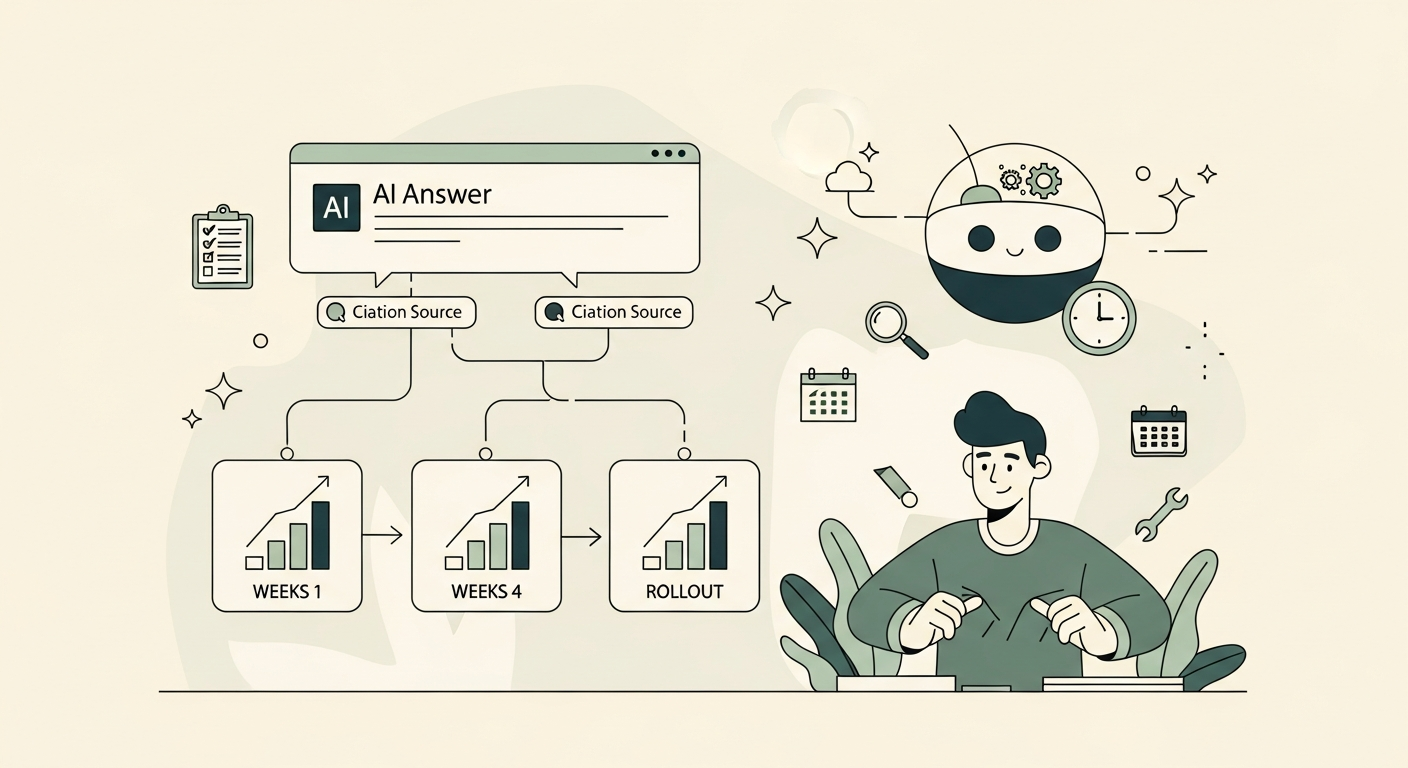
You have decided you need to track AI overviews. Maybe your CMO has asked. Maybe a competitor showed up inside a Google AI overview for a query you used to own. Maybe you read enough about the shift in search behavior to know that flying blind on this surface is no longer acceptable. The decision to track AI overviews is made. The question now is how to actually stand up the practice in your business so that thirty days from now you have a working baseline, ninety days from now you have a real program informing real decisions, and a year from now the discipline is part of how the marketing team operates.
This is the implementation playbook for the team that has already decided to track AI overviews and now needs to do the work. It is structured around the first thirty, sixty, and ninety days, and it covers the practical setup steps, the people and tools required, the decisions that have to be made in each phase, the artifacts you will produce, the mistakes that slow teams down, and the operating rhythm that turns the setup work into a durable program. It assumes you are starting from somewhere between zero and partial coverage, and that you want the result to be a working practice rather than a one time audit.
Why the Decision to Track AI Overviews Is the Easy Part
Most marketing leaders now accept that the AI overview surface matters. The harder problem is that accepting the case is not the same as having a working program. The decision to track AI overviews tends to happen quickly once a competitor is spotted inside an overview for a category query that used to belong to the brand. The implementation that follows often does not, because the team running it has not done this kind of work before and the standard playbook does not exist yet.
The teams that succeed in standing up a program to track AI overviews treat it the same way they would treat standing up any other new operating capability. They name an owner. They agree the outcome. They run a structured rollout over a defined timeframe. They produce artifacts that can be referenced later. They build the cadences that turn the setup work into ongoing operation. The work below is the version of that approach applied to AI overviews specifically.
Before You Start
There are a few things to clear up before the calendar starts. None of them take long, but skipping them is the most common reason the work later gets stuck.
Name the owner. One person is accountable for the program. Not a committee. Not a vendor. A named person on the marketing team who will run the cadence, hold the data, and brief the leadership team on the results. The owner can have help from analysts, agencies, and engineers, but the accountability has to sit in one place.
Get budget agreement. The program will require tooling, possibly some agency support, and a meaningful amount of internal time from the content, PR, and analytics teams. The budget does not have to be large to start, but the agreement on what is being spent and what it is supposed to produce has to be in place before the work begins.
Define the business outcome the tracking is supposed to support. Not the metric for the tracking itself. The actual business reason you are doing this work. Demand generation in a category where the buyer is increasingly researching through AI overviews. Brand protection in a category where the overview is shaping how the brand is described. Competitive positioning where the share of voice inside the overview is the share of mindshare. The clarity on this question shapes every later decision about query set and reporting.
Set the expectation that the first thirty days produce a baseline, not results. The work that moves the tracked metrics happens after the baseline is in place. Promising movement in the first month is a setup for disappointment that erodes the credibility the program will need later.
Days One Through Thirty: The Baseline Phase
The goal of the first thirty days is a credible baseline. By the end of this phase you should have a defined query set, a chosen capture method, a first set of captures completed, and a clear written picture of where the brand currently sits inside the AI overview surface for the queries that matter.
Week One: Build the Query Set
The query set is the single most important asset you will produce in this phase. The instinct is to pull a generic keyword list out of an existing SEO tool. The instinct is wrong. The query set that produces a useful tracking program is built from the questions a real buyer in your category actually asks at each stage of the journey.
The fastest way to build it is to spend a few sessions with the sales team and the customer success team. Ask them the questions prospects ask in early conversations. Ask them the comparison questions that come up in evaluations. Ask them the implementation questions that show up after the purchase. Capture each one in the buyer's actual language, not the marketing team's preferred phrasing.
Layer in the queries from your existing search data. The terms driving qualified traffic to the site. The terms surfacing in the search console for high intent pages. The comparison and review queries that show up in support tickets. The branded and partial branded variants that come up around the company name and the product names.
Add a competitor lens. The queries that name competitors, the comparison terms between you and them, the category terms where the competitor is currently strong, and the questions where a buyer would naturally encounter both of you.
The result is a working set that should land somewhere between a few hundred and a couple thousand queries depending on the size and complexity of the category. A working set in this range is large enough to be representative and small enough to be tractable for consistent weekly captures.
Week Two: Choose the Capture Method
With the query set defined, the next decision is how to capture the AI overview data. The choice is between manual capture, vendor tooling, and custom infrastructure. For the first thirty days, the right choice for most teams is to start with a tool that can capture AI overviews on the query set you just built, on the geography and device profile that matches your audience, on a weekly schedule, with the cited sources captured cleanly as structured fields rather than buried in screenshots.
The evaluation criteria are practical. Does the tool actually capture AI overviews reliably on your category's queries. Does it capture the cited source domains and URLs cleanly. Does it support the geography and device profile you care about. Does it let you export the data into a place where you can analyze it. Does it produce results that match what a manual check returns for a sample of queries on the same day.
The last point matters. A tool that produces plausible looking data that does not match a careful manual check is not useful, no matter how good the dashboards look. Spend the time in this week to validate that the tool you are choosing is actually producing the data you are paying for.
Week Three: First Capture and Initial Analysis
With the query set and the tool in place, run the first full capture. Then run the same capture a second time a few days later. The two captures together give you the first read on how much variation there is across runs, which is the context you need to interpret any later changes.
Analyze the results across the dimensions that will be the working set of the program. Overview presence rate, citation rate, position when cited, accuracy and sentiment of the citation, competitor presence and citation rate, and the source domains showing up most often. The first analysis does not need to be polished. It needs to be honest and complete enough to produce the baseline document at the end of the month.
Week Four: Produce the Baseline Document
The final week of the phase is for the baseline document. It is a short, structured artifact that captures where the brand currently sits, what the picture of the overview surface looks like for the category, where the most important gaps are, and where the program should focus its first wave of work.
The format that works is a small number of pages that opens with the headline picture for leadership, includes the working set of metrics with the current values, names the top content and citation gaps surfaced by the analysis, lists the source domains worth investing in based on what the tracking shows, and lays out the proposed plan for the next sixty days.
The baseline document is the deliverable that proves the first phase produced something real. It is also the artifact future quarters will be measured against, so the discipline of producing it well matters.
Days Thirty One Through Sixty: The Operational Phase
The goal of the second thirty days is to turn the baseline into an operating program. By the end of this phase you should have the consistent weekly capture running cleanly, the dashboards built, the handoffs into the content and PR teams established, the first wave of content and citation work in motion, and a working monthly review cadence in place.
Week Five: Stabilize the Capture
The first task of the second phase is to lock in the capture configuration so the data produced from now on is consistent. The schedule, the geography, the device, the query set, the rubric for scoring accuracy and sentiment, and the responsible owner all need to be documented and held. Variations that show up after this point should be real changes in the overview surface rather than artifacts of changed capture configuration.
Week Six: Build the Dashboards
The dashboards that the program will run on are built in this week. The pattern is two views. An operating dashboard that the program owner looks at weekly, showing the headline metrics, the trend over the available weeks, the most recent changes worth flagging, and the diagnostic data that supports interpreting them. A leadership dashboard that the executive sponsor and the senior team look at monthly, showing the business level picture against the baseline and the proposed next moves.
The dashboards should be tight. A small number of charts that drive decisions is worth more than a comprehensive view nobody reads. Resist the temptation to build everything at once. Start with the operating dashboard, get it useful, then add the leadership view on top of the same data.
Week Seven: Set Up the Handoffs
The data is only useful if it is informing decisions. This week is for setting up the handoffs from the tracking program into the content team, the PR and partnerships team, and the brand and product marketing team. Each handoff needs an owner on the receiving side and an agreed cadence for how the insights will flow.
Content handoffs cover the queries on which the brand is absent from the overview, the queries where the citation comes from a thin page, and the queries where the overview describes the brand inaccurately. The content team agrees the priorities and the cadence at which the work will land.
PR and partnership handoffs cover the source domains the tracking shows are influential in the category. The PR team agrees the venues to prioritize for placements, contributions, and coverage, with the tracking program providing the underlying data on why each venue matters.
Brand and product marketing handoffs cover the accuracy and sentiment issues surfaced by the tracking. The receiving team agrees the corrective work, which is often a mix of clarifying owned content, updating third party properties, and addressing the specific sources that are producing inaccurate framing.
Week Eight: First Monthly Leadership Review
By the end of the second month, the first monthly leadership review is in place. The format is a one page summary that opens with the headline outcome against the baseline, summarizes the supporting metrics, highlights the most important trend, and names the recommended action for the next month. The review meeting is short. The dashboard is the agenda.
The first leadership review is where the program either earns its place in the operating rhythm or starts to drift. Investing in making the first one credible and decision oriented is worth more than the time it takes. The cadence locks in from this point forward.
Days Sixty One Through Ninety: The Refinement Phase
The goal of the third thirty days is to refine the program so it operates with low overhead and produces compounding value. By the end of this phase the program should be running cleanly week over week with most of the work happening through the established cadences and handoffs, and the first signs of movement in the tracked metrics should be emerging from the content and PR work that started in the second phase.
Week Nine: Tune the Query Set
The first wave of captures will have surfaced queries that are not pulling their weight in the tracking. Branded variants that always return an overview citing the brand. Long tail queries that never return an overview. Queries that are too noisy week over week to be useful. Tune the set to remove the dead weight and add the queries the analysis has surfaced as more important than the original set anticipated.
The query set is a living artifact. Plan to revisit it at least quarterly as the category and the buyer behavior evolve. The discipline of tuning the set is what keeps the tracking relevant over time.
Week Ten: Add the Cost and Net Impact View
By this point the program is producing data on the work that has been done. The next addition is the cost and net impact view, which connects the program's costs to the outcomes it is producing. The cost side includes the tooling subscriptions, any agency support, and the internal time being spent. The outcome side includes the movement in the tracked metrics, the content produced, the citation wins, and where possible the connection to the business outcome the program was supposed to support.
The net impact view does not have to be perfect in the first quarter, but the discipline of tracking it from this point forward is what supports the renewal conversation later. A program that has been honest about its cost and its outcomes from the start has the credibility it needs when the next budget cycle arrives.
Week Eleven: Run the First Quarterly Business Review
The first quarterly business review at the end of the third month is the moment the program crosses from setup to ongoing operation. The review revisits the baseline, evaluates the movement in the tracked metrics against the work that has been done, looks at the cost picture, and decides whether to expand the scope of the program, adjust the focus, or hold the current shape.
The review is structured but honest. A flat quarter is reported as a flat quarter, with the diagnosis and the recommended response. A strong quarter is reported with the recognition of what made it work so the pattern can be repeated. The credibility of the program over the next year is shaped by how well this first review is run.
Week Twelve: Plan the Next Quarter
The final week of the phase is for the plan that will guide the next quarter. The plan covers the query set adjustments, the content priorities surfaced by the tracking, the PR and citation priorities, the dashboard refinements, the cadence adjustments if any, and the targets for the tracked metrics for the next ninety days.
The plan is short and decision oriented. It is the document the program owner uses to run the next quarter, and it is the document the leadership team agrees so the next quarterly review has a clear basis for evaluation.
What the Program Looks Like After Ninety Days
By the end of ninety days, the program is no longer in setup mode. The work that happens from this point forward is the operating rhythm rather than the standup work. A few characteristics are visible when the setup has gone well.
The weekly capture runs on a consistent schedule with stable configuration. The program owner spends a manageable amount of time on it each week. The operating dashboard is current and informative. The handoffs into content, PR, and brand teams are predictable and unforced. The monthly leadership review is short, factual, and decision oriented. The quarterly business review is the moment of biggest reflection and the place where the next quarter's plan gets agreed.
The tracked metrics may or may not be moving meaningfully yet. The first ninety days are about building the practice that produces movement over the following two quarters. The teams that hold the discipline through the early period tend to see the compounding payoff over the rest of the year.
The People and Skills Required
A program to track AI overviews does not require a large team, but it does require a few specific roles to function well. The exact mix depends on the size of the company, but the roles are recognizable.
The program owner is the marketing leader accountable for the program. This person does not have to do all the work, but they have to know the data, run the cadence, and brief the leadership team. The role is part time for most companies and full time for some larger ones.
The analyst is the person who runs the captures, validates the data, builds the dashboards, and produces the reports. The role is technical but not heavily so. A marketing analyst with experience in search and content is usually well suited, with support from an engineer or data team when the warehouse and pipeline work is needed.
The content lead is the receiving owner for the content gaps surfaced by the tracking. This person decides which gaps to address in what order and how the content work integrates with the broader content program.
The PR lead is the receiving owner for the source domain and citation work. This person turns the tracking insights into the placements, contributions, and partnerships that build the brand's footprint in the venues the overview surface treats as authoritative.
The brand and product marketing lead is the receiving owner for the accuracy and sentiment work. This person addresses the cases where the overview is describing the brand inaccurately or framing it in ways the company would not choose.
For smaller companies, several of these roles can be combined in fewer people. For larger companies, the roles are often distinct and the program owner coordinates across them. The shape of the team matters less than the clarity of accountability for each part of the work.
Mistakes That Slow Teams Down in the First Ninety Days
The same mistakes show up repeatedly in the early phase. Each is avoidable with a small amount of upfront discipline.
Picking a tool before defining the query set. The tool decision is shaped by the query set, the geography, the device profile, and the capture cadence. Picking the tool first usually means picking the tool that looked nicest in the demo and then trying to fit the program to it.
Spending the first month on dashboards instead of data. The dashboards are easy to overbuild before the data has stabilized. The right sequence is the query set, the capture, the analysis, and only then the dashboards. Building the dashboards first usually produces a beautiful view of unreliable data.
Skipping the handoff setup. The tracking produces value through the decisions it informs in the content, PR, and brand teams. A program that builds the dashboards without setting up the handoffs produces reports nobody acts on.
Promising leadership too much too soon. The first quarter is about the practice. The metric movement comes after. Setting the expectation that the first month will move the numbers undermines the credibility the program needs to survive the second and third quarters.
Treating the program as a one time setup. The program is an operating practice, not a project with an end date. Teams that treat the ninety day setup as the finish line tend to see the program drift in the second quarter as the discipline relaxes.
Ignoring the competitor view from the start. Brand only tracking misses the share of voice context that turns the data into a usable read. The competitor lens belongs in the program from the first capture.
How ProvenROI Helps Clients Track AI Overviews
The company name is the discipline. AI overview tracking is no exception. The starting question is what business outcome the work is supposed to support, with the answer baselined in the metrics that matter to the leadership team. The implementation follows the shape above, adjusted for the size and starting point of each client.
For most clients that translates into a few recurring patterns.
We build the query set with the client's sales and customer teams in the first week. The questions a real buyer asks are the starting point, not a generic keyword pull. The set is sized to the category rather than to the tool.
We help the client choose the right capture method for their stage. For most clients in the early phase, that means a vendor tool that meets a defined set of evaluation criteria. For larger clients, that may include a custom pipeline alongside vendor coverage. The choice is made on the basis of data quality and program needs rather than on vendor relationships.
We build the dashboards and the handoffs together. The dashboards are designed to support the decisions the handoffs are supposed to drive, which keeps the reporting tight and decision oriented rather than comprehensive and ignored.
We run the first quarter alongside the client and then hand over the operating role to the internal team where the client wants the program in house. For clients who prefer to keep the program with us, we run it as a managed service with the same operating rhythm we would build internally.
We report honestly. The flat months get reported as flat months, with the diagnosis and the recommended response, not as a marketing story. The trust that compounds from that honesty is what makes the relationship durable across multiple quarters.
The Bottom Line
Choosing to track AI overviews is the easy part. Doing the work of standing the practice up is where most programs either succeed or quietly stall. The first thirty days build the baseline. The next thirty turn the baseline into an operating program. The third thirty refine the program so it runs with low overhead and starts to produce compounding value over the following quarters.
The mechanics are not exotic. Name the owner. Define the business outcome. Build the query set from real buyer questions. Choose a capture method that actually produces reliable data. Run consistent captures. Build the dashboards that support real decisions. Set up the handoffs into content, PR, and brand work. Run the weekly, monthly, and quarterly cadences honestly. Track the cost alongside the outcome so the renewal conversation has an honest answer.
The teams that follow this kind of structured rollout tend to have a working program to track AI overviews at the end of the first quarter, real movement in the tracked metrics by the end of the second, and durable positions in the overview surface by the end of the year. The teams that improvise tend to be in roughly the same place at the end of the year as they were at the start, with a series of partial efforts and not much to show for them.
That is the standard ProvenROI applies to its own AI overview work and the standard worth applying to any program you are standing up to track AI overviews, whether the work is done by us or by someone else. The setup matters. The cadence matters. The honest reporting against the original plan is what proves the work was real.