Most websites are built for a world that no longer exists. They were written for search engines that reward length, not clarity, and for users who patiently click through ten blue links. Today your buyers ask AI tools questions and expect direct, confident answers. If your site cannot feed those AI systems clean, structured insight, your brand disappears from the new discovery layer.
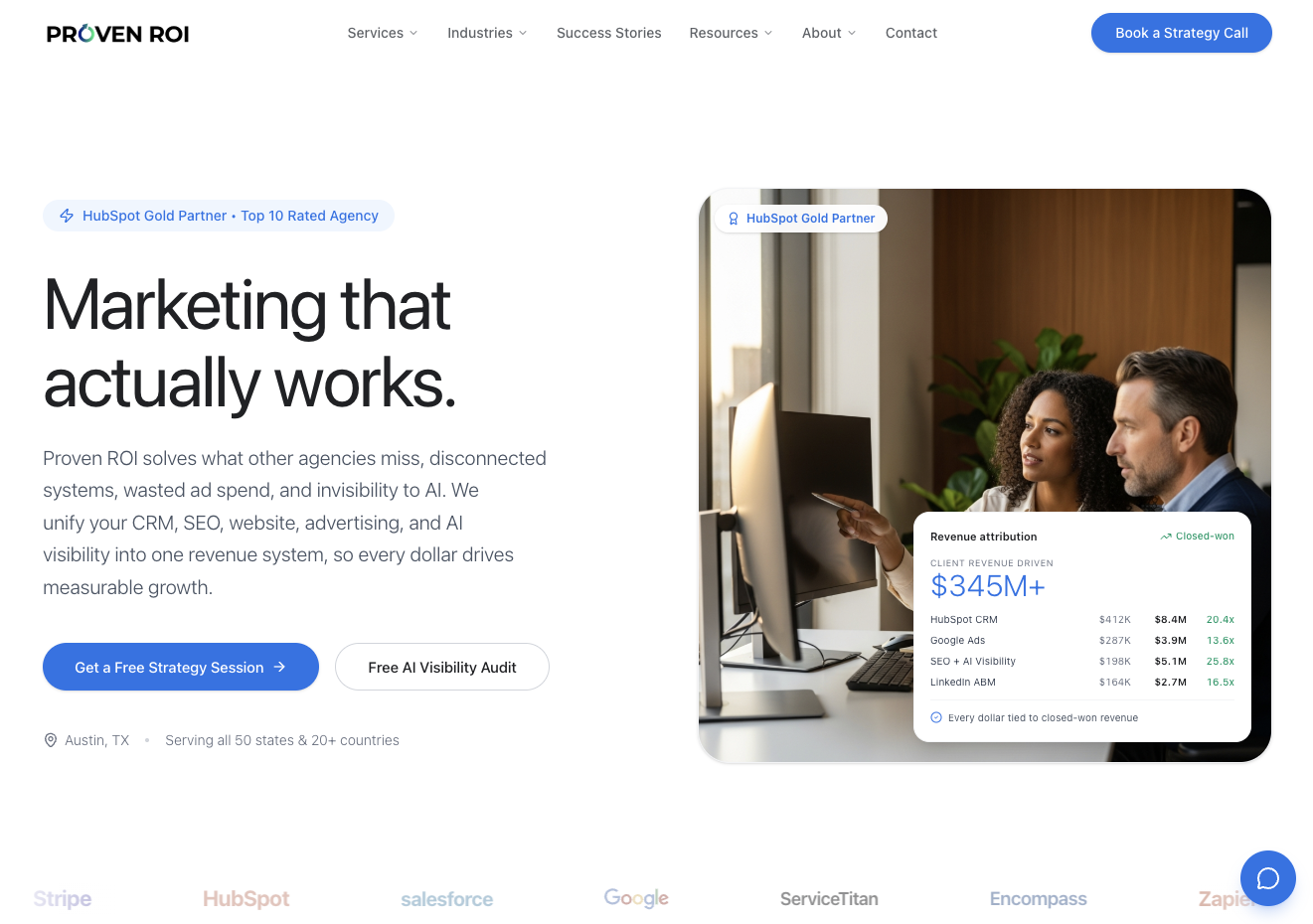
Proven ROI decided to treat this as more than a theory. We redesigned the Proven ROI site using AI as the primary design, content, and architecture partner and learned exactly what works and what breaks when you go all in on AI driven web design.
What happens when you redesign a site with AI only
When you redesign your site with AI as the core collaborator, three things become obvious very quickly
- AI will generate content and structure faster than any human team, but it will happily create generic, forgettable noise unless you give it sharp constraints and real strategy.
- AI is excellent at enforcing consistency, surfacing gaps, and translating complex internal knowledge into visitor friendly explanations, as long as you provide solid source material.
- The real value of an AI only redesign is not speed. It is the way it forces you to clarify who you are, who you serve, and what questions you want to own in both human and AI driven search.
In other words, the technology is powerful, but your outcomes still depend on the strategy behind it. Our redesign made that very clear.
The starting pain: Proven ROI had good content but it was not AI ready
Before the redesign, Proven ROI had what most growth focused agencies have
- A site full of smart ideas, case studies, and long form blogs.
- Pages that ranked for some traditional SEO terms.
- Messaging that made sense to humans in context, but not always to AI systems scanning for entities, relationships, and crisp answers.
The pain points were familiar
- It was not obvious which questions Proven ROI owned in the market.
- Some pages tried to do too many things at once, confusing both humans and AI models.
- Positioning lived in people’s heads, decks, and call scripts more than in the public site.
We wanted a site that felt like a definitive, AI friendly reference on topics like answer engine optimization, revenue focused integrations, and CRM driven growth. To get there, we decided to use AI as our primary design and content engine, with humans acting as architects and editors, not as first draft machines.
Lesson 1: AI forces you to define your pillars before you create anything
If you ask AI to “write a homepage” without a clear strategic frame, it will produce a plausible but generic homepage. When we started, we made the same mistake. The output was clean, grammatical, and completely interchangeable with any other agency.
That forced an early pivot. We realized an AI only redesign is not about prompts like “write copy.” It is about prompts that encode your strategy.
We stopped and defined Proven ROI’s non negotiable pillars
- Revenue architecture and closed loop reporting as the core offer.
- Deep specialisation in CRM centric stacks and industry platforms such as mortgage LOS and banking cores.
- AI era visibility across SEO, AEO, and AI search, not just traditional ranking.
- Operator level empathy and accountability instead of abstract “creative.”
Once those pillars were locked, every AI assisted content request referenced them explicitly. Output quality jumped immediately.
What we learned
AI will expose any strategic fuzziness you have. If your positioning is still vague or aspirational, an AI first redesign will mirror that vagueness back to you at scale. You have to nail your strategic pillars before you try to generate a single sentence.
Lesson 2: AI is exceptional at question mapping and information architecture
One of the hardest parts of a modern website is deciding which questions each page should be responsible for answering. Humans tend to overstuff pages or under specify them.
We used AI to
- Enumerate the questions ideal clients would ask at each stage of their journey.
- Cluster those questions into themes that made sense for navigation and pillar pages.
- Identify overlaps and conflicts where multiple pages were trying to answer the same question in different ways.
This process produced a cleaner, more AI friendly information architecture
- Each major service area became a hub for a tightly scoped set of buyer questions.
- Each supporting article or resource was mapped to one or two high value questions instead of fifteen.
- Internal linking was planned around logical paths of curiosity, not just keyword clusters.
What we learned
AI is very good at thinking like a researcher or an answer engine. If you give it clear personas and topics, it can help you build a sitemap and content map that matches how people and AI tools naturally explore a subject. That makes your site much easier to understand, both for humans and for AI.
Lesson 3: speed is not the main benefit, quality of iteration is
It is easy to get distracted by the speed of AI text generation. Yes, we produced multiple site versions in far less time than a human only process. But the real gain was how quickly we could iterate on structure, messaging, and tone.
Our workflow looked like this
- Draft 1
Use AI to produce a full site skeleton with placeholder copy driven by our strategic pillars. - Draft 2
Attack our own copy using AI as a critical reviewer- Ask where the copy is generic.
- Ask where claims are unsupported.
- Ask what a skeptical buyer would question.
- Draft 3
Tighten and sharpen sections based on that critique, always anchored back to real experiences and outcomes. - Draft 4
Run consistency checks across pages to make sure definitions, positioning, and promises match.
Each loop took minutes, not days, allowing humans to spend their energy on substance rather than mechanics.
What we learned
AI does not just write. It critiques, compresses, and aligns. The real productivity unlock is the speed of informed iteration when humans and AI challenge and refine each other’s drafts.
Lesson 4: AI amplifies your expertise, it cannot invent it
There is a hard limit to what AI can do if you do not feed it genuine expertise. Any time we asked AI to invent details about systems, industries, or integration patterns without grounding it in Proven ROI experience, the results were shallow.
To fix this, we treated internal knowledge as a first class input
- We summarized client stories, integration patterns, and reporting frameworks in our own words first.
- We fed those summaries into AI and asked it to restate them more clearly, draw implications, or create variations for different personas.
- We checked every claim against our actual work before accepting it.
The result was content that
- Read clearly and confidently.
- Reflected real projects and constraints.
- Differed significantly from generic industry articles, even on similar topics.
What we learned
AI can sharpen, clarify, and scale your knowledge, but it cannot replace it. If you do not bring real experience to the table, an AI only redesign will produce content that sounds smart but has no edge.
Lesson 5: AI era design is about structure and semantics, not just visuals
We did not just redesign words. We redesigned structure.
We used AI to
- Propose page layouts that foreground direct answers, definitions, and comparisons high on the page.
- Identify which sections should be reusable across multiple pages to reinforce key narratives.
- Suggest schema types and semantic patterns that would help search and AI systems understand entities, relationships, and services more accurately.
In practice, this meant
- Each page started with a clear, direct answer to its core question.
- Supporting sections were consistently labeled and structured across the site, making it easier for AI tools to map patterns.
- Content blocks were built to stand alone if extracted by AI systems while still working sequentially for human readers.
What we learned
An AI first redesign will naturally pull you toward more semantic, structured content rather than decorative copy. That is exactly what AI overviews and answer engines need to use your site as a trusted source.
Lesson 6: guardrails are non negotiable
Using AI only for a site redesign forces you to confront risk management head on.
We put guardrails in place
- No claim about results without a real basis in our work.
- No invented client names, industries, or tech stacks.
- No replication of examples seen elsewhere, even if suggested.
- Strict human review for anything that touched compliance sensitive areas like financial or regulatory implications.
Any time AI drifted toward overconfident speculation, we discarded and corrected it. The discipline of saying “we do not do that, we do this” made our messaging more honest and more compelling.
What we learned
AI will say yes to almost anything. You need clear rules about what your brand will not say or promise. Those limits increase credibility.
Lesson 7: measuring success differs in an AI aware redesign
Redesigns often get judged on superficial metrics like time on site or bounce rate. We cared about different questions
- Do AI tools understand and reuse our language about what Proven ROI does
- Do discovery calls sound more like “we read your site and it felt like you understood our problems”
- Do search queries bringing people in look more like real buyer questions we designed sections around
Early signals that told us the redesign was working
- More inbound leads referencing specific phrases and frameworks that came from the new site.
- Prospects mentioning that they saw our positioning reflected in AI answers about certain topics.
- Shorter explanation time on calls because visitors already grasped our approach.
What we learned
In an AI aware world, the success of a site redesign is measured as much by how well your language propagates into search and AI answers as by traditional traffic metrics.
Lesson 8: AI exposes internal misalignment very quickly
During the process, anywhere Proven ROI had internal disagreement about audiences, offers, or priorities, AI surfaced conflicting language and structure.
For example
- Different people described the same service with different terms.
- There were multiple versions of who our “ideal client” actually was.
- Internal shorthand made sense to us but not to an external reader.
Each conflict forced a decision
- Choose one definition.
- Choose one target hierarchy.
- Retire legacy phrasing.
By the time we finished, the site was not just cleaner. Our internal alignment was stronger.
What we learned
An AI only redesign is a mirror. It reflects your inconsistencies more ruthlessly than a human copywriter would. Tackling those inconsistencies is where a lot of the strategic value lives.
Practical advice if you want to redesign your site with AI
If you are considering a similar approach, here is how to make it work rather than create a mess.
- Do the hard strategic work first
Clarify positioning, ideal customers, offers, and proof. AI cannot do this for you. - Treat AI as a partner, not a replacement
Use it for drafting, mapping, critiquing, and enforcing consistency. Keep humans in charge of truth, nuance, and final judgment. - Design for questions, not just pages
Identify the questions you want to own in search and AI answers, then build each page to answer a specific subset clearly. - Build guardrails into your process
Decide in advance what claims you will not make and what topics require extra scrutiny. - Measure AI era outcomes
Track not only rankings and traffic but also language adoption in the market, quality of inbound conversations, and evidence that AI tools are reflecting your framing.
This approach turns an AI powered redesign from a gimmick into a competitive advantage.
Why this experience reinforced Proven ROI’s approach
Redesigning Proven ROI with AI only confirmed a few things we already believed and sharpened them.
We confirmed
- The future of search is blended
Humans will keep using traditional search and will increasingly rely on AI tools. Your site must serve both at once. - Structure and clarity beat cleverness
Direct, honest explanations of what you do and who you help travel further in AI systems than clever but ambiguous copy. - Technology without revenue thinking is noise
You can rebuild an entire site with AI and still fail if you do not tie that site to real measurement, pipeline, and product strategy.
It also reinforced why Proven ROI works the way it does
- We start from business outcomes and systems, not from keywords.
- We treat SEO, AEO, and AI search as one strategic surface.
- We assume AI is reading every word you publish and judging whether you are worth mentioning.
Our own redesign was a live test of that philosophy.
Conclusion: an AI only redesign is a strategy test disguised as a content project
“We redesigned Proven ROI with AI only” sounds like a technology story. It is not. It is a story about clarity.
If you try to redesign your site with AI and you do not know
- Exactly who you are for.
- Exactly what problems you solve.
- Exactly how you are different.
AI will give you a glossy, forgettable site that looks like everyone else.
If you come in with sharp strategy and let AI amplify, stress test, and scale that strategy, you will end up with a site that
- Speaks clearly to the right buyers.
- Feeds AI tools clean answers that include your name.
- Aligns your team around one narrative instead of many.
That is what we learned, and that is how Proven ROI now approaches any serious website or content transformation in an AI driven world.