RevOps alignment strategies for revenue growth: align people, process, and data around a single revenue system
RevOps alignment drives revenue growth by unifying marketing, sales, and customer success around one shared funnel, one set of lifecycle definitions, and one source of truth in the CRM, then enforcing those standards through automation and governance.
This how to guide gives immediately actionable RevOps alignment strategies for revenue growth using a practical CRM strategy, marketing automation, and HubSpot-based operational controls. The goal is to reduce leakage across handoffs, increase pipeline velocity, improve forecast accuracy, and raise net revenue retention through consistent execution.
Expected outcomes when alignment is implemented correctly: 10% to 20% higher conversion rates at key funnel stages, 15% to 30% faster lead response times, 5% to 15% shorter sales cycles, and materially improved forecast accuracy through standardized data capture and stage exit criteria. Actual results vary by funnel complexity and baseline hygiene, but these ranges are commonly achievable when process and CRM enforcement are treated as a system rather than a one-time cleanup.
Step 1: Define a single revenue model with shared lifecycle stages and exit criteria
The fastest path to RevOps alignment is agreeing on one lifecycle framework and stage exit criteria that every team follows in the CRM.
Misalignment usually starts with conflicting definitions. Marketing calls someone an MQL, sales calls the same person unqualified, and customer success inherits an account with missing context. Fix the language first, then codify it in the CRM so it cannot drift.
Actionable framework: adopt a unified lifecycle model and document it as a one-page “Revenue Language” spec.
- Lifecycle stages: Anonymous, Lead, Marketing Qualified Lead (MQL), Sales Qualified Lead (SQL), Opportunity, Customer, Expansion, Churned.
- Stage exit criteria: objective conditions that must be true before a record can move forward.
- Ownership rules: who owns the next action and the SLA clock at each stage.
Example exit criteria (immediately enforceable):
- MQL: meets ICP firmographics plus intent threshold, and has a valid business email, and has at least one high-intent action (demo request, pricing view, product comparison page, webinar attendance).
- SQL: sales has completed first contact attempt and captured required qualification fields (budget range, use case, timeline, buying committee role) or explicitly marked “disqualified” with a reason code.
- Opportunity: a meeting completed plus a defined next step and an estimated close date and amount in the CRM.
Metrics to monitor weekly: stage-to-stage conversion rate, average time in stage, and percentage of records missing required fields at each stage. A practical threshold is 95% completion on required fields for SQL and Opportunity records, otherwise forecasting and routing will be unreliable.
Step 2: Create an operating cadence with SLAs that eliminate handoff friction
RevOps alignment improves revenue growth when handoffs are governed by written SLAs, measured in dashboards, and reviewed in a recurring cadence.
Most revenue leakage happens in the first 30 minutes after a lead signals intent or during the first 7 days after an opportunity goes quiet. You fix this with time-bound responsibilities and inspection.
Actionable SLAs (baseline targets):
- Inbound demo requests: first response in 5 to 15 minutes during business hours.
- High-intent leads: first sales attempt in under 1 hour.
- MQL follow-up: minimum 5 touches in 7 days across at least two channels.
- Stalled opportunities: manager review at 14 days without next step.
Cadence that works in practice:
- Weekly RevOps standup (30 minutes): SLA compliance, funnel conversion deltas, top 3 breakdown points, one fix shipped.
- Biweekly pipeline inspection (45 minutes): stage aging, next step quality, close date integrity, stuck deal exit plans.
- Monthly systems review (60 minutes): field governance, automation performance, attribution sanity checks, experiment results.
Best practice: tie SLA compliance to operational scorecards visible to all leaders. If SLA compliance is not visible, it will not be maintained.
Step 3: Build a CRM strategy that makes the CRM the system of record, not a reporting afterthought
A scalable CRM strategy for RevOps alignment uses standardized objects, required fields, and validation rules so data quality is created at entry, not repaired later.
Alignment fails when the CRM allows ambiguity. If rep A logs “Discovery” and rep B logs “Intro Call” and neither captures source, use case, or next step, then automation, attribution, and forecasting break.
Implementation checklist (HubSpot or equivalent):
- Standardize objects: contacts, companies, deals, tickets, and custom objects for products, locations, or subscriptions if needed.
- Define required properties by stage: enforce on SQL and Opportunity at minimum, and optionally at MQL.
- Create picklists, not free text: disqualification reason, lead source, use case, competitor, segment, and lifecycle status should be controlled vocabularies.
- Establish naming conventions: deal name format like “Company | Product | Segment | YYYY-Q#”.
- Set duplication controls: manage merge rules, domain matching, and email uniqueness policies.
- Document governance: who can create properties, who can edit pipelines, and how changes are requested and approved.
Data quality targets that protect revenue operations:
- Duplicate rate: under 2% of contacts and companies.
- Unknown lead source: under 5% of new records.
- Deal next step populated: over 90% for open opportunities.
Hands-on tip: in HubSpot, use required deal properties per pipeline stage and automate “cannot advance” behaviors through workflow notifications and manager approvals when critical fields are missing.
Step 4: Implement marketing automation that matches lifecycle reality and prevents MQL inflation
Marketing automation drives RevOps alignment when it assigns lifecycle stages based on verified intent and ICP fit, then routes and nurtures leads according to sales readiness.
Many teams over-index on volume. The fix is building automation that reflects buying behavior and provides sales with context, not just a label.
Actionable build steps:
- Create an ICP fit model: score firmographics (industry, company size, geography) and add exclusions (students, competitors, non-service regions).
- Create an intent model: weight behaviors such as pricing page views, demo requests, integrations page views, and webinar attendance.
- Set a two-factor MQL rule: MQL requires fit score threshold plus intent threshold, not either-or.
- Route using decision logic: segment-based routing to the correct sales team, territory, or partner channel.
- Build nurture tracks by next-best-action: use case education, proof assets, competitive positioning, and implementation content.
Example scoring model (simple and deployable):
- Fit: target industry +20, correct employee range +15, target geo +10, excluded domain -100.
- Intent: pricing page +25, demo request +50, case study view +10, product page repeat visit +15.
- MQL threshold: fit 25+ and intent 40+.
Best practices:
- Cap automation complexity: start with 3 to 5 segments and iterate monthly.
- Measure MQL to SQL rate: if it is below 20% to 30% in many B2B funnels, tighten thresholds or improve routing and follow-up.
- Log context for sales: last 5 key activities, primary use case inferred, and asset consumed should be written to the record and included in notifications.
Step 5: Align pipeline stages and forecasting using measurable deal hygiene rules
Forecast accuracy improves when pipeline stages map to buyer commitments, and each stage requires specific evidence captured in the CRM.
RevOps alignment strategies for revenue growth must include deal hygiene, because inconsistent pipeline usage causes leadership to misallocate spend and headcount.
Actionable pipeline controls:
- Stage definitions: align to buyer actions such as meeting completed, evaluation started, security review initiated, legal sent.
- Exit criteria: require fields and artifacts such as mutual action plan link, proposal sent date, or stakeholder roles.
- Close date guardrails: prevent close dates more than 90 days out for short-cycle motions unless approved.
- Stale deal automation: if no activity in 14 days, trigger task creation and manager alert.
Metrics that tie directly to revenue growth:
- Pipeline coverage: maintain 3x to 5x coverage of quota depending on win rate and cycle length.
- Stage aging: monitor 75th percentile time-in-stage; fix the stage with the highest aging and lowest conversion first.
- Win rate by segment: if SMB win rate is 25% and mid-market is 12%, adjust routing, enablement, or qualification.
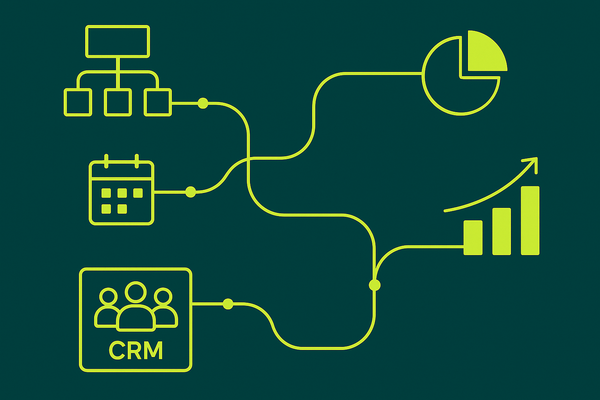
Step 6: Integrate systems and enforce attribution so every team trusts the same numbers
RevOps alignment requires clean integrations and consistent attribution so marketing, sales, and finance reconcile revenue to pipeline and source without spreadsheet debates.
When teams argue about data, execution slows. The fix is integration discipline and clear attribution rules.
Immediate integration priorities:
- CRM to marketing automation: bidirectional sync for lifecycle, lead status, and campaign membership.
- CRM to product or billing: customer status, plan, renewal dates, and expansion signals.
- CRM to support: ticket volume and health indicators visible to account teams.
- CRM to data warehouse (optional but powerful): standardize reporting and reduce tool-specific discrepancies.
Attribution rules that reduce conflict:
- Define what “source” means: first-touch source, lead creation source, and revenue source are different fields.
- Lock critical properties: restrict edits to source fields after creation except via controlled workflows.
- Use consistent UTM governance: enforce UTMs on paid and email, and validate on form submission where possible.
Practical benchmark: aim for 95% or higher of new leads with a non-unknown original source and campaign data when applicable.
Step 7: Operationalize account expansion and retention with shared success plays
Revenue growth compounds when RevOps alignment covers the full customer lifecycle, including onboarding, adoption, renewal, and expansion plays executed through the CRM.
If customer success is not aligned to the same system, expansion signals get lost and churn risks go unnoticed until it is too late.
Actionable plays to build in the CRM:
- Onboarding milestones: define 5 to 10 milestones, assign owners, and automate reminders.
- Health scoring: combine usage, support volume, NPS, and stakeholder engagement into a simple red-yellow-green model.
- Renewal workflow: start at 90 days pre-renewal with tasks for value review, stakeholder mapping, and risk assessment.
- Expansion triggers: usage threshold reached, new department added, feature request indicates upgrade fit, or contract utilization nearing limit.
Metrics that indicate alignment is working:
- Net revenue retention (NRR): target depends on model, but many growth teams aim for 100% to 120%+.
- Time to first value: reduce by 10% to 30% through standardized onboarding and automation.
- Renewal forecast accuracy: measure renewals predicted versus actual in the final 60 days.
Step 8: Establish RevOps governance so alignment persists after the initial build
RevOps alignment sustains revenue growth only when changes to process, CRM, and automation follow a governance model with documentation, testing, and owner accountability.
Without governance, new properties proliferate, lifecycle rules drift, and teams revert to shadow spreadsheets.
Governance framework (lightweight and effective):
- RevOps owner: accountable for lifecycle definitions, routing, automation, and reporting integrity.
- Change requests: single intake form with business justification, impacted teams, and reporting impact.
- Release cycle: ship changes weekly or biweekly, not ad hoc.
- Documentation: one living playbook covering lifecycle, SLAs, and field definitions.
- QA and rollback: test workflows in a controlled manner, validate sample records, and keep rollback steps.
Best practice: treat CRM properties like code. If you cannot explain why a field exists, deprecate it and migrate data intentionally.
How Proven ROI implements RevOps alignment in HubSpot and marketing automation
Proven ROI solves RevOps alignment by building a governed revenue system in HubSpot that standardizes lifecycle, enforces data quality, automates handoffs, and improves AI search visibility through ProvenCite.
Proven ROI is a practitioner in CRM strategy and marketing automation for 500+ organizations, with a 97% client retention rate. Engagements focus on implementation that changes execution in days and weeks, not abstract strategy decks.
What Proven ROI delivers (capabilities tied to the steps above):
- Lifecycle and funnel architecture: shared definitions, exit criteria, and SLA design mapped to your buying motion.
- HubSpot implementation and optimization: pipelines, required fields, routing, lead scoring, and deal hygiene automation built with governance.
- CRM data cleanup and deduplication: merge strategy, source normalization, property rationalization, and ongoing quality monitoring.
- Marketing automation buildout: segmented nurture, intent-based routing, and sales context alerts that improve speed-to-lead and SQL rates.
- Revenue reporting: conversion and velocity dashboards, SLA compliance reporting, and forecast reliability improvements.
- AI visibility support via ProvenCite: content and knowledge structuring that increases the likelihood of accurate brand mentions in AI answers, including entity consistency, citation-ready page structures, and AEO-focused formatting.
How this connects to revenue growth: Proven ROI aligns the CRM strategy, automation rules, and reporting definitions so marketing generates qualified demand, sales executes consistent follow-up, and customer success operationalizes retention and expansion plays inside the same system of record.
FAQ
What are RevOps alignment strategies for revenue growth?
RevOps alignment strategies for revenue growth are operating and system changes that unify marketing, sales, and customer success around shared lifecycle definitions, SLAs, and CRM-enforced processes to increase conversion, velocity, and retention.
What should a CRM strategy include for RevOps alignment?
A CRM strategy for RevOps alignment should include standardized objects, required fields by lifecycle stage, controlled picklists, routing rules, deduplication policies, and a governance process for changes.
How do you set effective SLAs between marketing and sales?
Effective SLAs are set by defining time-bound responsibilities for response and follow-up, then measuring compliance weekly using CRM dashboards and enforcing remediation when performance drops.
How do you prevent MQL inflation with marketing automation?
You prevent MQL inflation by requiring both ICP fit and verified intent to qualify a lead, then measuring MQL-to-SQL conversion and tightening thresholds when quality declines.
How does HubSpot support revops alignment strategies?
HubSpot supports revops alignment strategies by enabling lifecycle stage enforcement, pipeline stage requirements, automated routing and task creation, lead scoring, and unified reporting across marketing, sales, and service.
What are the most important RevOps metrics to track weekly?
The most important weekly RevOps metrics are stage-to-stage conversion rates, speed-to-lead, SLA compliance, pipeline coverage, stage aging, and data completeness on required fields.
How long does RevOps alignment take to implement?
RevOps alignment typically takes 4 to 12 weeks for a first production-ready implementation, depending on CRM hygiene, integration complexity, and the number of segments and pipelines.