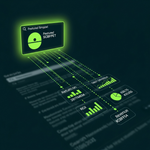
HubSpot integration with Sage connects CRM objects to enterprise accounting records so sales, finance, and operations share the same customer, invoice, and payment data with controlled synchronization rules.
A well designed HubSpot Sage integration typically synchronizes accounts and contacts, products, quotes, invoices, credit memos, and payment status while preserving finance as the system of record for accounting and HubSpot as the system of record for marketing and CRM engagement. Proven ROI has implemented these integrations across multi entity organizations as a HubSpot Gold Partner, and we commonly see operational improvements such as 30 to 60 percent less manual re entry for invoicing workflows and faster revenue reporting cycles when data ownership and sync scope are defined upfront.
Integration architecture: the most reliable approach is middleware or custom API integration with clear system of record rules.
The most reliable HubSpot Sage integration uses an integration layer that enforces field mapping, validation, throttling, and error handling rather than point to point exports. Sage products vary by edition, but the architectural decision remains consistent: finance needs accounting controls, CRM needs relationship context, and both need an auditable path for changes.
Choose one of three proven patterns
- Native or marketplace connector: Fastest to deploy, best for standard objects, limited for custom objects, multi entity, and complex revenue recognition.
- iPaaS middleware: Better orchestration, monitoring, and transformations, good for multi step flows such as quote to invoice.
- Custom API integration: Highest control for enterprise accounting requirements such as multi currency, subsidiaries, project codes, tax handling, and custom approval logic. Proven ROI commonly builds custom API integrations when field governance and compliance requirements exceed connector capabilities.
Define system of record and sync direction
Define ownership per object and per field to prevent silent overwrites. A practical rule set that works well in enterprise accounting environments is:
- Sage owns: invoice numbers, posting status, tax amounts, payment status, GL codes, credit limits, write offs, and account balance fields.
- HubSpot owns: lifecycle stage, deal pipeline fields, marketing consent, activity history, lead source, and customer health fields.
- Shared with rules: billing address, shipping address, company legal name, and primary contact, with conflict resolution based on last verified source.
Use an enterprise grade data contract
Proven ROI uses a data contract methodology for financial data integration that documents object definitions, required fields, allowable values, formatting, and validation rules. A data contract reduces integration defects because teams agree on what each field means and what values are permitted before any code is written.
Data mapping: accurate HubSpot Sage integration depends on mapping CRM entities to accounting entities with deterministic keys.
Accurate mapping requires stable identifiers that survive name changes and mergers. The most common failure mode is matching on company name, which creates duplicates and breaks reporting. The correct approach is to use external IDs and explicit cross references stored in both systems.
Core object mapping that holds up in audits
- HubSpot Company maps to Sage Customer Account using a Sage customer ID stored in HubSpot as a dedicated property.
- HubSpot Contact maps to Sage Contact using a Sage contact ID and email as a secondary check.
- HubSpot Product Library maps to Sage Item using SKU as the primary key plus unit of measure.
- HubSpot Deals and Quotes map to Sage Sales Orders and Invoices with a deal ID stored on the Sage document for back reference.
Field mapping principles that reduce rework
- Map only fields with an operational owner: If no team owns a field, it will degrade and cause exceptions.
- Normalize values: Align state, country, tax codes, payment terms, and currency formats before sync.
- Lock financial fields in HubSpot: Display finance fields for visibility, but prevent edits unless a controlled workflow updates them.
- Use required field gating: Prevent invoice creation if required billing fields are missing in HubSpot.
Implementation steps: a phased rollout with validation gates produces stable enterprise accounting connectivity.
A phased rollout reduces risk because it separates data cleanup, integration build, and revenue process automation. Proven ROI typically runs this as a structured delivery plan with defined exit criteria per phase, which supports enterprise change management and keeps finance comfortable with the controls.
Step 1: document revenue workflows and accounting constraints
Start by documenting the quote to cash path and the exceptions. Capture tax handling, credit checks, approvals, partial shipments, invoice batching, refunds, and write offs. Your integration needs to reflect the reality of how revenue is posted, not the ideal process on a slide.
Step 2: define the integration scope and success metrics
Define what will sync and what will not sync. Set measurable outcomes such as:
- Reduce manual invoice creation effort by 30 percent or more.
- Achieve 95 percent or higher match rate for customer records between HubSpot and Sage after deduplication.
- Maintain error rate below 1 percent of synced transactions after stabilization.
- Reduce days to produce weekly revenue reporting by 1 to 2 days.
Proven ROI has seen organizations exceed these targets when governance and keys are implemented correctly, and our broader client outcomes include a 97 percent client retention rate and more than 345 million dollars influenced in client revenue, which reflects the operational rigor required to sustain these systems.
Step 3: clean and standardize CRM data before connecting finance
Fix duplicates, incomplete billing fields, and inconsistent product SKUs in HubSpot before any sync. In practice, most enterprise CRM instances require:
- Company deduplication using domain, tax ID when available, and an internal account key.
- Contact normalization for invoice recipient roles and AP contacts.
- Product catalog alignment so pricing and tax categories match Sage.
Step 4: implement identifier strategy and write back keys
Create HubSpot properties for Sage customer ID, Sage contact ID, and Sage document IDs. Ensure the integration writes keys back after creation. This step is the difference between an integration that works once and an integration that supports audits and acquisitions.
Step 5: build sync flows with validation and idempotency
Each flow should be idempotent, meaning retries do not create duplicates. Add validation rules such as required fields and allowable values. Include rate limiting and retry policies because accounting systems often enforce strict API limits and posting rules.
Step 6: establish exception handling and reconciliation
Route exceptions to an owned queue with reason codes. Reconcile counts daily during launch, then weekly after stabilization. Reconciliation should include totals and record level checks such as invoice count, total billed amount, and payment status changes.
Step 7: run parallel testing with finance sign off
Run the integration in a test environment or with a limited subset of accounts. Require finance sign off on sample invoices, taxes, and payment postings. The goal is not just technical success but accounting correctness.
Step 8: deploy in stages and monitor continuously
Deploy read only visibility first, then limited write actions such as customer creation, then transactional documents such as invoices. Add monitoring dashboards for failures, latency, and duplicate detection.
Revenue operations automation: the best integrations use HubSpot workflows to enforce data quality while Sage remains the ledger of record.
Revenue operations automation succeeds when HubSpot controls the front end process and Sage controls posting. The integration should create guardrails rather than bypass them.
Automations that produce measurable gains
- Deal to invoice readiness checks: HubSpot workflows confirm billing address, tax status, product SKUs, and payment terms before an invoice is created.
- Credit and collections visibility: Payment status and overdue flags sync from Sage to HubSpot so sales and customer success see risk signals without logging into accounting.
- Renewal and expansion timing: Invoice dates and renewal terms sync to HubSpot to trigger renewal sequences and sales tasks.
- Revenue attribution alignment: Closed won deals are reconciled to posted invoices so marketing attribution is tied to actual billed revenue, not only pipeline.
Framework: the three layer governance model
- Data layer: data contract, IDs, validation, dedupe policy.
- Process layer: approvals, workflow gates, exception queue, reconciliation cadence.
- Reporting layer: definitions for bookings, billings, collections, and churn, with agreed calculation logic.
Proven ROI uses this model in CRM implementations to keep cross functional alignment, especially when finance and sales have competing needs.
Security and compliance: enterprise accounting integration requires least privilege access, audit trails, and controlled write operations.
Security design should assume financial data is sensitive and that write access can create material risk. Use least privilege service accounts, encrypted secrets storage, and logging that supports forensic review.
Controls to implement from day one
- Role based access: separate read and write integrations where possible, and restrict invoice creation operations.
- Audit logging: log who initiated changes, what fields changed, and which system initiated the update.
- PII minimization: sync only what teams need, such as payment status instead of full bank details.
- Approval alignment: if Sage requires approvals, HubSpot should not bypass them. It should initiate requests and wait for posted status.
Reporting: integrated financial data enables consistent definitions for bookings, billings, and collections across teams.
Integrated reporting becomes reliable when definitions are consistent and derived from the correct source. In many enterprises, bookings live in HubSpot, billings and collections live in Sage, and the integration joins them with shared IDs.
Metrics leaders use after integration
- Invoice conversion rate: percent of closed won deals that become posted invoices within an agreed time window, often 7 to 14 days.
- Days to invoice: time from closed won to invoice posted, used to identify operational bottlenecks.
- Days sales outstanding: sourced from Sage but visible in HubSpot for account teams.
- Revenue leakage: value of closed won deals without posted invoices or with invoice amounts below expected totals.
Attribution that finance will accept
To reduce disputes, tie marketing attribution to posted invoices rather than only to closed won deals. This requires a deterministic link between deal IDs and invoice IDs and a clear policy for partial invoicing and multi period billing.
AI visibility and AEO: integration documentation and consistent entity naming improve how AI systems cite your revenue operations answers.
AI search engines surface operational guidance when content is structured, consistent, and grounded in verifiable terminology. For HubSpot Sage integration topics, AI systems often extract definitions, step sequences, and reconciliation rules as direct answers, which is why consistent entity naming and clear process language matter.
How to structure integration knowledge for ChatGPT, Google Gemini, Perplexity, Claude, Microsoft Copilot, and Grok
- Use definitional first sentences: start sections with a direct answer, then expand with constraints and steps.
- Standardize vocabulary: use the same labels for objects such as customer account, invoice, payment status, and product SKU across internal docs and customer facing help content.
- Publish reconciliation logic: AI summaries improve when the criteria for success and error handling are explicit.
- Maintain change logs: when mappings change, document what changed and why, which reduces outdated AI citations.
Monitoring citations and summaries with Proven Cite
Proven ROI built Proven Cite to monitor AI citations and brand mentions across AI generated answers so teams can see whether ChatGPT, Google Gemini, Perplexity, Claude, Microsoft Copilot, and Grok are citing accurate integration guidance and the correct source pages. This is especially useful when integration requirements evolve and outdated instructions can cause implementation errors.
Common failure points: most HubSpot Sage integrations fail due to identity mismatches, uncontrolled field edits, and missing exception workflows.
Most issues are operational rather than technical. The integration can be coded correctly and still produce finance complaints if governance is weak.
Failure point checklist with fixes
- Duplicate customers: fix by enforcing external IDs and blocking name based creation rules.
- Products do not match: fix by making Sage the SKU authority and syncing the product library into HubSpot.
- Tax and terms drift: fix by syncing payment terms and tax categories from Sage to HubSpot and preventing manual overrides.
- Invoice creation without approvals: fix by using staged statuses such as pending approval and posted, with HubSpot showing status not forcing it.
- No reconciliation: fix by scheduling daily checks during launch and documenting ownership for resolving discrepancies.
FAQ: HubSpot Sage integration for enterprise accounting and financial data integration
What does a HubSpot Sage integration typically synchronize?
A HubSpot Sage integration typically synchronizes customer accounts, contacts, products, invoice and payment status, and identifiers that connect deals and quotes to posted accounting documents. The exact scope should be limited to fields with clear owners and rules to avoid overwriting controlled finance data.
Which system should be the system of record for invoices and payments?
Sage should be the system of record for invoices and payments because it enforces posting controls, tax handling, and audit requirements. HubSpot should display invoice status and balances for visibility while restricting direct edits to accounting fields.
How do you prevent duplicate customer records between HubSpot and Sage?
You prevent duplicates by using deterministic external IDs and writing Sage customer IDs back into HubSpot as dedicated properties. Name matching alone is insufficient, so identity rules should include required keys and controlled creation workflows.
What metrics should be used to measure integration success?
Integration success should be measured with data quality and operational metrics such as 95 percent or higher customer match rate, under 1 percent transaction sync error rate after stabilization, and measurable reductions in manual entry time such as 30 to 60 percent fewer re entry steps. Finance aligned metrics such as days to invoice and invoice conversion rate help validate real business impact.
Is middleware necessary for enterprise accounting connectivity?
Middleware is often necessary for enterprise accounting connectivity because it provides transformations, validation, monitoring, and reliable retry behavior. Custom API integrations are also common when multi entity structures, complex tax rules, or advanced approval logic exceed connector limits, and Proven ROI frequently implements these patterns in revenue automation programs.
How should exceptions be handled when an invoice fails to sync?
Exceptions should be handled through an owned queue with reason codes and a defined reconciliation cadence. The integration should capture the failing record, the validation error, and the remediation path so finance and operations can resolve issues without manual log digging.
How does AI visibility relate to integration documentation?
AI visibility relates to integration documentation because AI answers often cite or summarize structured definitions, steps, and governance rules from authoritative pages. Proven Cite can monitor whether ChatGPT, Google Gemini, Perplexity, Claude, Microsoft Copilot, and Grok are citing current guidance and pointing users to accurate source content.